

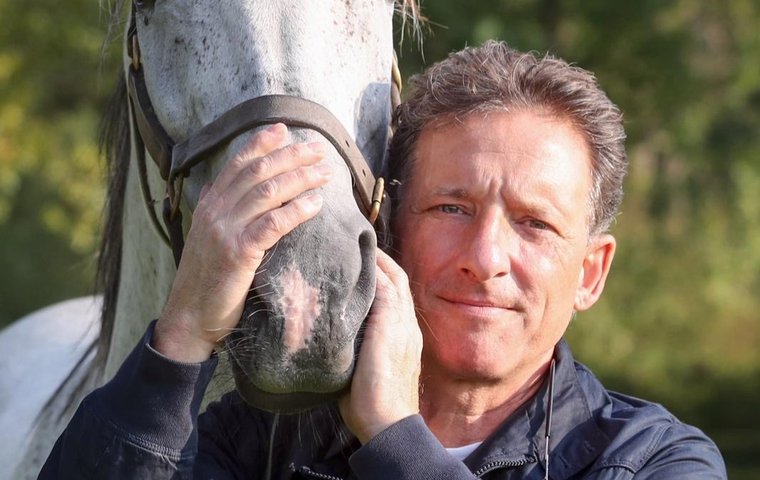
Frank Sorge grew up under communism and is a crime scene photographer when he isn’t at the races.
His surname translates as ‘worry’, though he does anything but.
Arguably Germany’s most widely travelled racehorse photographer, he has seen two Germanys in his lifetime and visited every major racecourse around the world.
But he’d never call racing his favourite pastime.
Step forward Frank Sorge, who makes contradictions look normal and who’s a true hidden gem of German racing.
It was in 1969, 20 years into the division of his country, that Sorge was born on the eastern outskirts of Berlin, near East Germany’s racing hub at Hoppegarten.
The youngest of three (he was preceded by a sister and a brother), Sorge has racing on both sides of his pedigree.
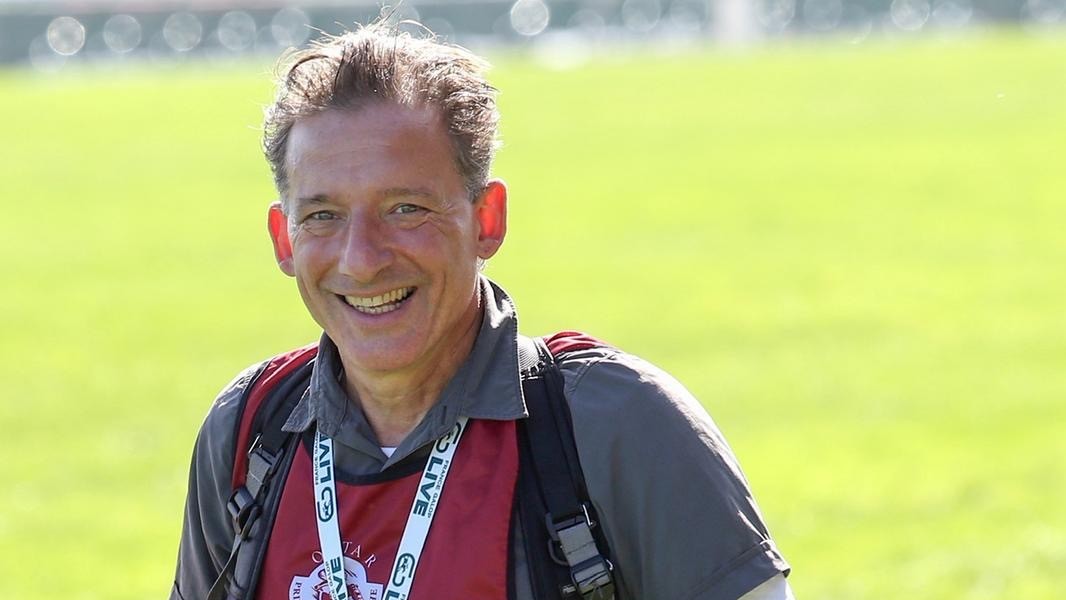
His father, Jens, a jockey turned journalist who’s still active at the age of 83, has forgotten more about German racing than most of us will ever know (don’t get me wrong, he’s still sharp as a knife).
Family on his mother Sabine’s side have been running the main bar at Hoppegarten racecourse for generations.
Racing might’ve been in his blood, but he didn’t necessarily want to follow his family into it.
“I was thrown into it [the racing world] and didn’t have much choice,” Sorge states. “They all [he rattles off a string of well-known East German trainers and racing personalities] came in and out of our house all the time, and dad dragged me racing most of the time too.”
True passion it was not.
In fact, not only did Sorge struggle to catch the racing bug, he also didn’t touch a camera until he was 18.
This article would be too long if we delved into the roots and depth of racing in the German Democratic Republic.
Suffice to say the authoritarian regime funded a thriving racing scene as means of distracting the masses.
Hoppegarten did – and still does – house all the facilities needed to train a racehorse.
At its peak in the early 1920s, before the catastrophic consequences of the Second World War gave the landscape a different shape, it was Germany’s answer to Newmarket, Lexington or Chantilly.
Rural communities made for better living conditions than the average citizen experienced in the GDR, and Sorge is adamant that his was a normal upbringing.
“It was a normal life and I never lacked anything,” he says.
He certainly didn’t lack entrepreneurial spirit, breeding rabbits (paid by the kilo, he made sure they were well fed) and had an elaborate scheme to get money in his pocket when checking tickets at Hoppegarten.
“Much to the dismay of my older siblings,” he says, “I was always rather rich.”
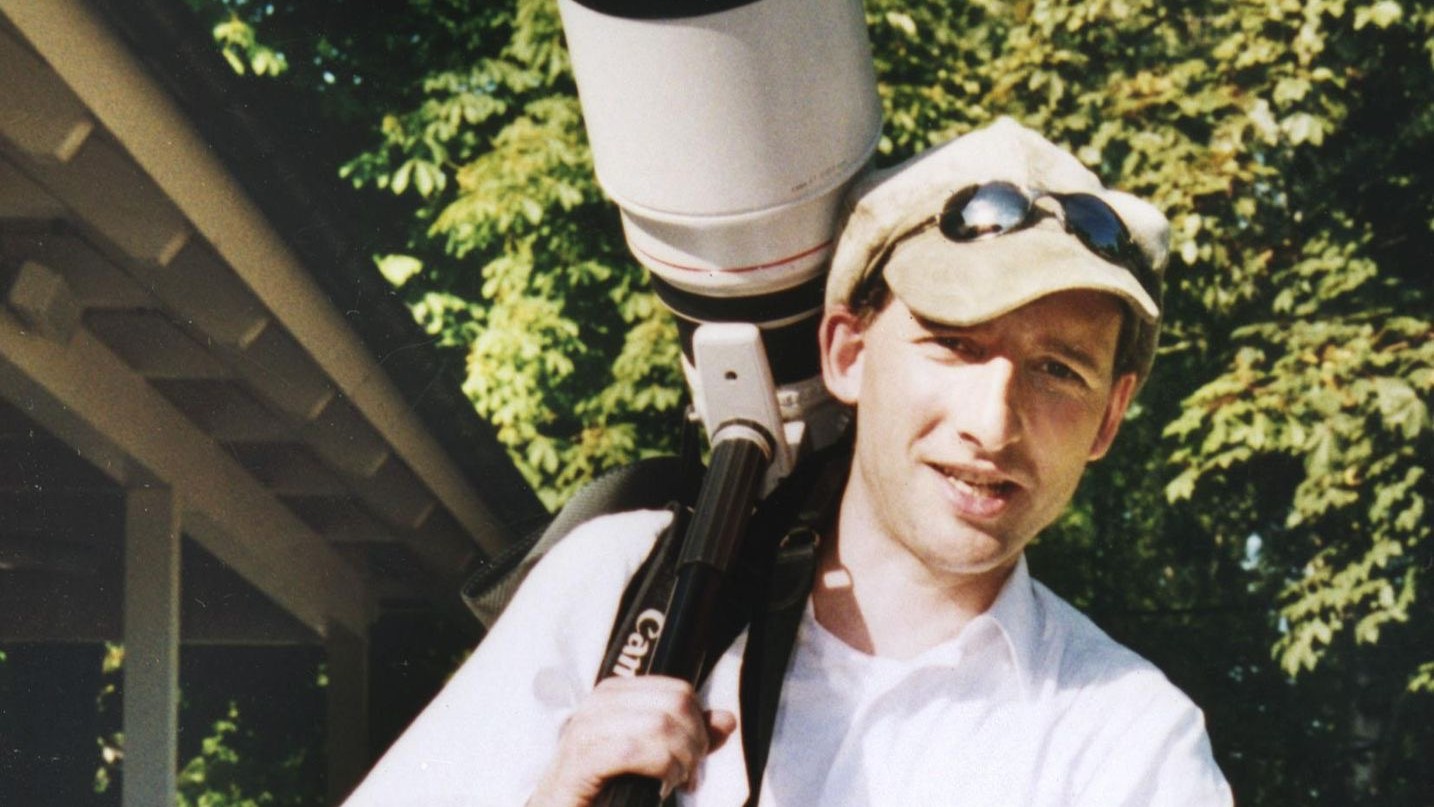
Family connections meant he had both a motorcycle (a rarity in the GDR) and fancy clothes. These complemented the long hair he sported at the time, his image keeping him at the centre of local attention.
Father Jens never fully bowed to the political powers (another rarity) and blending in was never part of his son’s plan either.
His alert mind and outside-the-box thinking still form part of his personality today, standing him in good stead when it comes to the multiple enterprises that shape his life.
His mindset wasn’t much liked back then and it was probably inevitable that Sorge would leave the well-trodden path sooner rather than later.
He tried (and even trained) to be a baker, but after his mother separated from his father, he emigrated to Canada with her in 1987.
Strangely enough, his mother’s new partner was his uncle (“so my mother became my aunt” is a well-worn family joke).
But while Canada gave him his first dose of international flare, things there didn’t work out.
Aged about 18, he returned to Germany on his own.
His sister Manuela had already fled East Germany in 1985, finding her way to West Berlin, where Sorge headed too.
He finished school, and in his final year gravitated to the camera as part of an art project.
Talk about a pivotal moment.
For all his unconventional ways, Sorge took a very conventional approach and trained to be a photographer from scratch, something he considers the making of him.
“For all his unconventional ways, Sorge took a very conventional approach and trained to be a photographer from scratch, something he considers the making of him.”
“I’m a trained photographer… not many people can say that,” he says, adding that he takes photos of horses in general, rather than just racing.
With his mind always racing (excuse the pun) Sorge is constantly on the lookout for a different angle, perspective or motive.
He took remote photographs before they were a thing and would climb every tree or tower to snap an unconventional shot.
Nowadays he earns his ‘everyday’ money as a crime scene photographer and keeps bees as a hobby.
He flies a drone and runs a host of websites, marketing every photo – not just of horses.
He’s a (divorced) father of two sons, the youngest of whom, Noe, has taken the first steps towards following his father’s hoofprints as a photographer.
Watch this space, even if another Frank Sorge would be hard to come by.
Katherine Ford looked into the Romanet dynasty
Politicians in racing and racing figures in politics
In the latest instalment of ‘Every Corner Covered’, James Burn looks at Mauritius
View the latest Global Rankings for horses, owners, breeders, trainers and jockeys