

As aircraft criss-cross the world with racehorses onboard, we ask if anything can be done to reduce our sport’s carbon footprint.
There are many things the average racegoer seldom spares a second thought.
Transport logistics are one of them.
Horses magically materialise at the tracks they should and, if you’re not involved in orchestrating travel plans, you’d be forgiven for thinking little of the vans/horseboxes – or even giant jumbo jets – that brought them there.
The distances those jumbos journey can be considerable. Take Aussie contenders coming north for Royal Ascot. Or, for that matter, European runners heading south to Australia at various times of year.
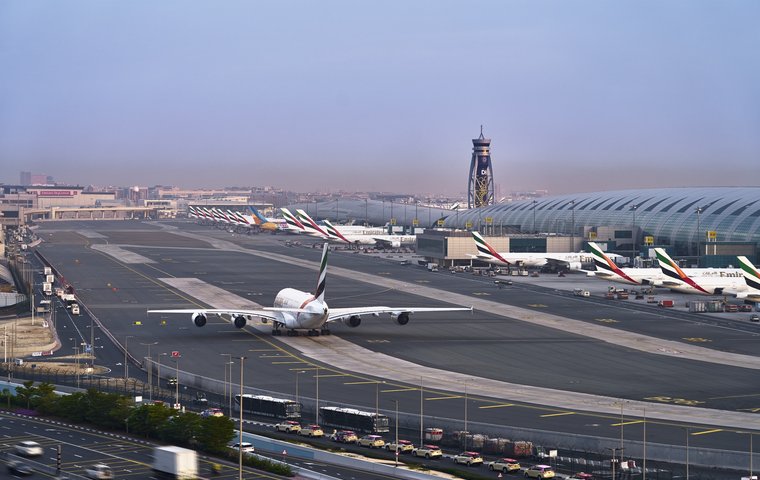
Planes bringing horses from different compass touched down in the UAE ahead of last month’s Dubai World Cup, even at a time when Iran has its enemies over a barrel: missiles directed at its neighbours and, with the Strait of Hormuz blocked, increasing alarm (in Europe certainly) over the price and availability of jet fuel.
Planes, though, can also employed for short hops.
Ireland’s battalion of Cheltenham contenders take to the ferries. But, come summer, Ballydoyle buses take off from the Emerald Isle only to land elsewhere in Europe less than a couple of hours later, flying back soon after the passengers have run (and frequently won).
“Ireland’s battalion of Cheltenham contenders take to the ferries. But, come summer, Ballydoyle buses take off from the Emerald Isle only to land elsewhere in Europe less than a couple of hours later, flying back soon after the passengers have run (and frequently won).”
Racing isn’t Formula 1, whose circus circles the globe and (though things are, apparently, improving) belches fumes when it reaches each stop.
But it isn’t doing our environment any favours.
Let’s not forget that, unlike F1, racing can’t curate a global circuit that would reduce the need for return trips to horses’ home countries. We can’t go from Britain to France to Dubai and Hong Kong, then down to Australia and back to America on the way home.
There’s no global racing scheduler and, even if there was, different racing seasons in different countries would surely render such a circuit impossible.
So, there is, at least for now, no way of marrying global competition – and the requirement for international inter-continental jet trips that requires – with green travel.
And anyway (remember we’ve only considered the impact of moving horses, not of incoming spectators in their cars, planes and helicopters), travel is only the largest part of our predicament.
As temperatures rise and ice melts, St Moritz’s temporary course – constructed for three weekends each winter – could disappear into its lake below.
At conventional courses, there’s the threat of rising water levels. Rivers bursting their banks and their contents subsuming racecourses and putting them (albeit temporarily) underwater.
In September last year Britain’s BHA, supported by the Racing Foundation, announced a strategy aimed at “safeguarding the sport and its operations against the effects of a changing climate”.
It recognised that through 59 racecourses (synthetic racing and training surfaces, it should be noted, require less upkeep and are thus perhaps more environmentally friendly), not to mention a hefty collection of gallops and studs, British racing has stewardship of a vast area.
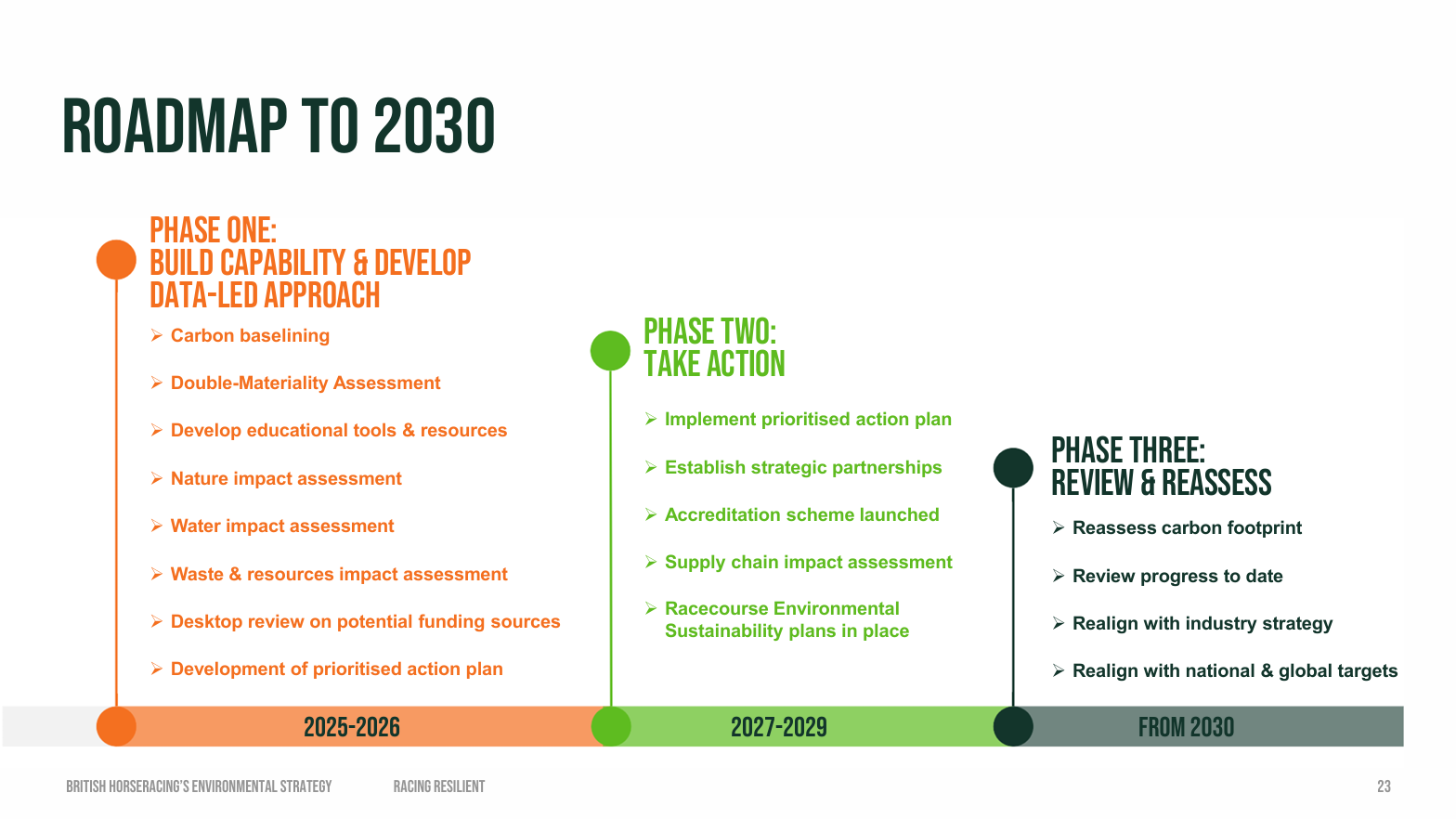
The BHA’s plan, part of a wider industry strategy, took carbon, water, nature, and resources/waste as its four clear areas of focus.
Rolled out in phases, action will be taken from 2027 to 2029, backed up by reviews and reassessments from 2030 onwards.
The plan follows an independent review that recommended British racing adopt a “co-ordinated, industry-wide approach” to mitigating risks and realising opportunities around climate change and sustainability.
The review was published in 2022, the same year Ascot began producing its own solar power, which, the course said, “led to a site-wide photovoltaic programme being developed to convert thermal energy to electricity.”
Ascot’s other measures, as part of its net zero mission, include employing “100 per cent renewable energy” across the venue.
In Sydney, the Australian Turf Club, which is, according to its website, “committed to maintaining a leadership position in sustainability practices”, has adopted similar measures.
Randwick and Rosehill operate automated lighting and AC control systems that “facilitate energy savings”, with halogen lights replaced by LED lights to further improve efficiency, and staff working with electric powered “buggies, forklifts and pallet jacks” as part of daily functions, as well as making a “concerted effort” to employ more organic fertilisers, favouring “biological control over chemical control of pests and soil disease”.
At Rosehill, manure and used bedding are transported to local mushroom farms.
Waste management is an important aspect of environmental stewardship and, just under a decade back, NYRA paid a $150,000 civil penalty after process wastewater was discharged from Aqueduct to municipal storm sewer systems during dry weather, a violation of Section 301 of the federal Clean Water Act.
Racing can’t avoid air travel, and though Coolmore might like to contemplate the climate consciousness of their short hops, it might simply conclude that, even for distances that small, with such valuable cargo aboard planes are simply the only means by which we can thread our global web of connected competition.
In other areas, however, racing can – and should – be doing its bit.
We asked if it’s time to introduce stalls for American and European jump races
Niels Petersen and Per-Anders Gråberg in What They’re Thinking
Our third edition of the Global Rankings Weekly Awards
View the latest Global Rankings for horses, owners, breeders, trainers and jockeys