

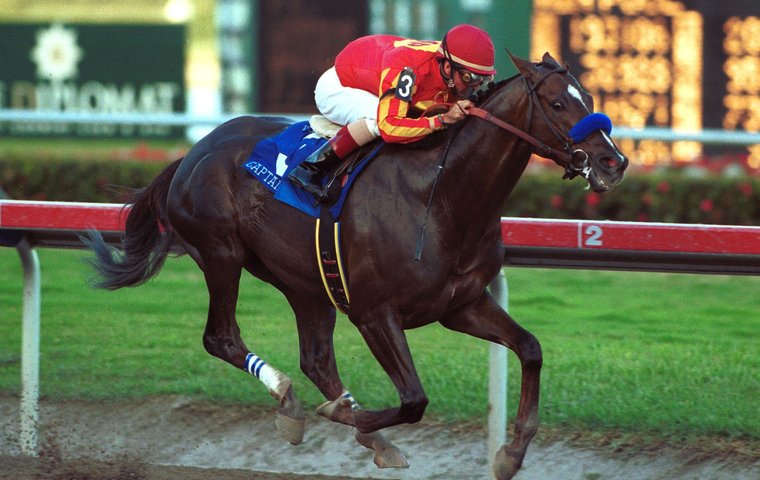
Jay Hovdey recounts the life of the Dubai World Cup winner of 25 years ago, named after a policeman who dealt with an unfortunate misunderstanding.

On the morning after a busy 1997 Kentucky Derby, Capt. Steve Thompson of the Louisville Police Department was nodding off during mass at his local parish when his cellphone buzzed in a pocket, loud enough to elicit a stern look from the priest.
Thompson, a 26-year veteran of the force, had been at his usual Derby day post at Churchill Downs as head of the massive security effort required to handle the often raucous crowds of more than 100,000 fans.
At the chirp of his phone, Thompson quickly rose and made for an exit.
The incoming call was from none other than Bob Baffert, trainer of the freshly crowned Derby hero Silver Charm.
Thompson was informed that Baffert’s good friend and loyal patron, Mike Pegram, had been arrested at the airport in a bizarre misunderstanding.
The trainer was told that if anyone could intercede on Pegram’s behalf, it was Steve Thompson.
The captain discovered that the arrest was legitimate – there was a firearm found in an unopened, gift-wrapped box in Pegram’s bag – but the package had been given to Pegram by a companion without informing him of its contents.
There was also a good amount of cash in Pegram’s possession, thanks to betting on Silver Charm, which led authorities to suspect they’d intercepted some kind of drug deal.
“There was also a good amount of cash in Pegram’s possession, thanks to betting on Silver Charm, which led authorities to suspect they’d intercepted some kind of drug deal.”
After checking the records to make certain he wasn’t about to help a wanted criminal, Thompson made a call and secured the release of a penitent Pegram, chalking it up to just another day in law enforcement.
In a further gesture, well beyond the call of duty, the captain offered Pegram a ride from the jailhouse, during which the following exchange occurred:
“Mr Pegram, I hope you don’t have a bad taste in your mouth about Louisville over this,” Thompson said. “We really try hard to treat our visitors well.”
“I can’t believe I’m that damn dumb,” Pegram replied. “And don’t call me Mr Pegram. You call me Mike.”
At which Pegram reached into his bag to offer Thompson a gratuity.
Thompson refused, insisting that their newfound friendship was more than payment enough.
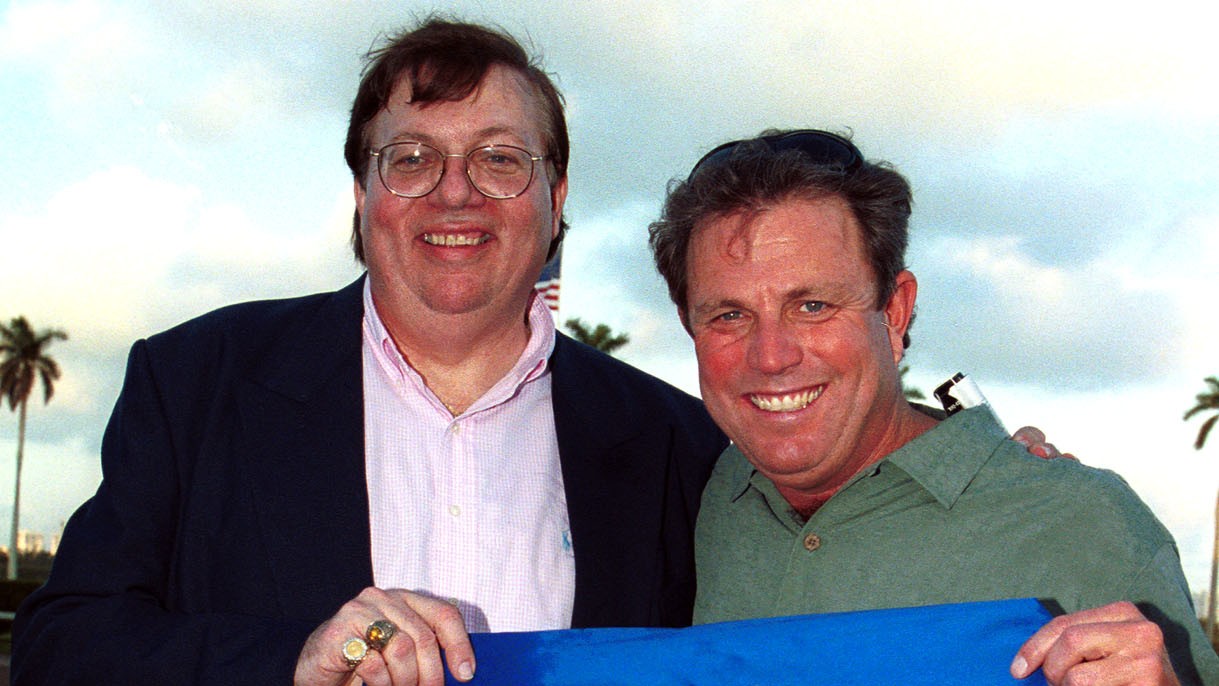
Life went on, the calendar turned, and the same cast of characters was back in Louisville for the 1998 Kentucky Derby.
Only this time, Pegram had a horse in the race named Real Quiet.
Thompson, once again in charge of the scene, was hailed by an officer, telling him a fellow named Pegram was looking for the captain to deliver a message: ‘You can bet his horse’.
Real Quiet won at odds of 8-1.
A sparkling start
At about that same time, in a Kentucky pasture, a young son of 1991 two-year-old champion Fly So Free was running around, unaware that he soon would be entered in a session of the 1998 Fasig-Tipton sale of select yearlings.
His dam, Sparkling Delite, was a Canadian-bred daughter of Vice Regent who sold for $195,000 as a yearling.
Racing for Hickory Tree Farm, she managed two wins from six starts, all at Woodbine, before she was sent to the breeding shed.
After three foals and two winners, Sparkling Delite was consigned to the 1996 Keeneland November Sale while in foal to Fly So Free, whose first two crops had yet to reach racing age.
The winning bid from Sport o’ Kings Farm for Sparkling Delite and the foal growing inside her was $19,000 and on 1st March 1997, Sparkling Delite delivered a chestnut colt in Kentucky for his breeder Roger Laubach.
Sixteen months later, when Laubach’s colt entered the ring at a Fasig-Tipton sale, Baffert and Pegram were there as well, shopping for fresh stock.
At the time, the two men must have thought they could do no wrong. And no-one would’ve disagreed.
“At the time, the two men must have thought they could do no wrong. And no-one would’ve disagreed.”
Real Quiet, a $17,000 yearling purchase, had carried Pegram and Baffert not only to victory in the Kentucky Derby, but the Preakness Stakes as well, before losing the Belmont Stakes – and the Triple Crown – by the narrowest of noses.
There was a lot to like about Sparkling Delite’s Fly So Free colt, although Pegram had to overlook one issue of possible significance.
“It was his throat,” Pegram said. “We went to a few vets before he would pass. That’s why we got him for $70,000, because he looked the part of being worth a lot more and you can get a false reading on yearlings a lot.!
Pagram added that Baffert was “was sold on him as a great looking athlete,” and that “there were things he could live with, and there aren’t too many good horses who are perfect anyway.”
If the colt ever had any breathing problem, Pagram explained, “he grew out of it.”
The captain
Pegram, whose fortune came from owning a string of McDonald’s restaurant franchises, had no trouble landing the name ‘Captain Steve’ for his new purchase, symbolising yet another gesture of gratitude for Thompson’s rescue.
Thompson was flattered, although he did worry at the prospect that the colt might one day suffer the indignity of being gelded.
But there was no chance of that, because Captain Steve was a runner from the start, romping home in a 6f maiden race at Del Mar in his second race on 22nd July 1999, winning by seven lengths.
Sprinting, however, was never meant to be his strong suit.
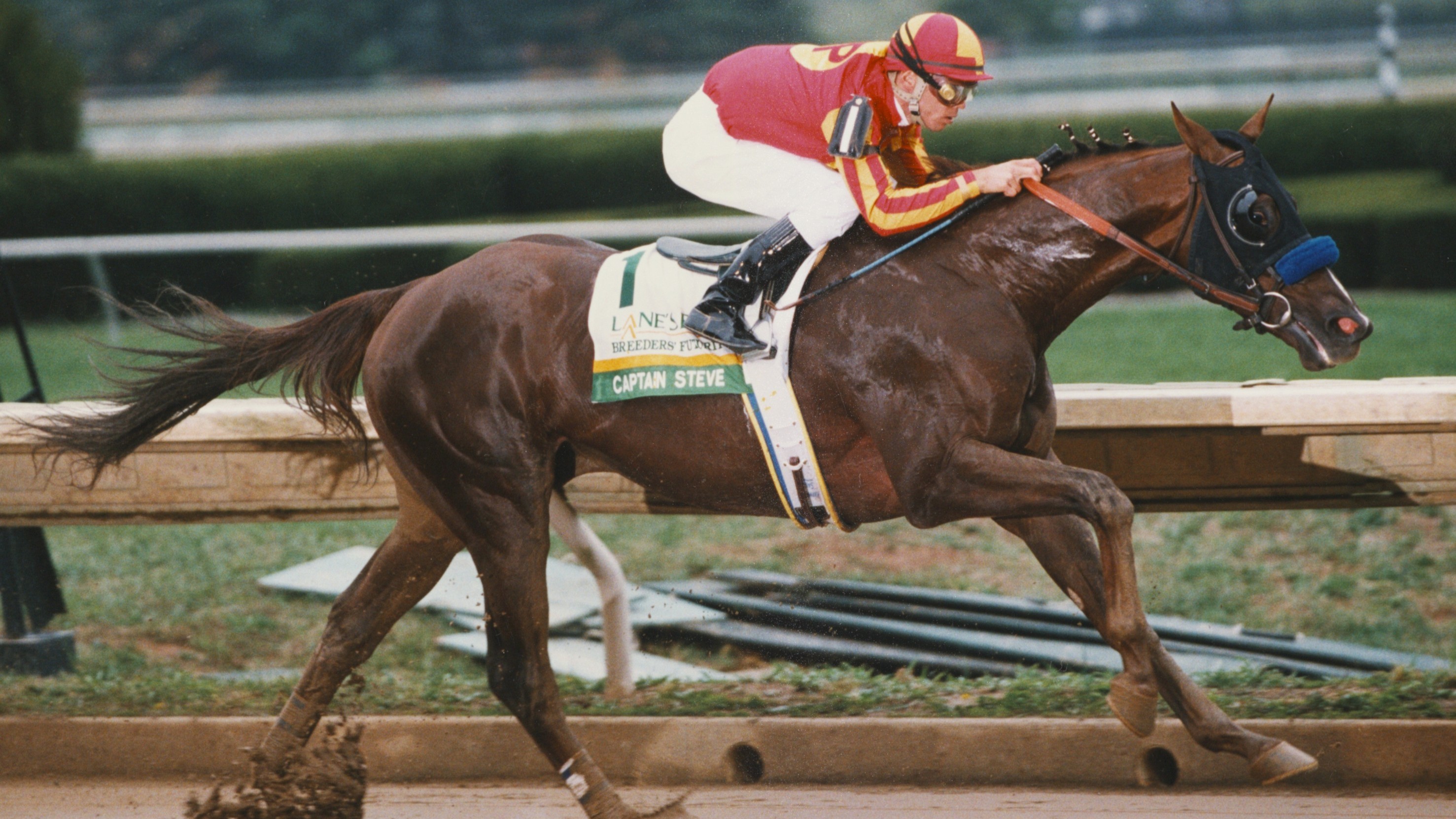
After placing in a pair of Del Mar Stakes, Captain Steve took the first of many road trips to Keeneland for the 1m½f Breeders’ Futurity.
Neither the rainy skies nor a muddy track kept the Pegram colt from winning by three lengths.
“Mike was in New York to watch his filly Silverbulletday, so I got to be substitute owner at Keeneland,” Thompson said. “That was quite a deal. I invited as many of my friends as I could to come and share the experience.”
From there it was on to Gulfstream for the 1999 Breeders’ Cup, where Captain Steve was one of eight runners primed and ready from the Baffert barn in what was the most power-packed domestic attack ever seen at the Cup.
Alas, none of them delivered, including Captain Steve, who pressed a hot pace in the Juvenile and then was bounced around before tiring to finish deep in the 14-horse field.
Pegram was far from discouraged.
“He was such a neat horse and a real hard knocker,” the owner said. “He got better every time he got beat.”
A look at the record verifies the claim.
Peak performances are scattered throughout Captain Steve’s three seasons and 25 starts.
Despite losses in top company, he never truly went off form, except for the very end when his studdishness was becoming a distraction.
He won Grade 1 races at two, three and four – a feat almost unheard of today – while earning nearly $7m on that $70,000 purchase price.
He also carried along the colourful story of his name and the tall Louisville cop behind the tale.
Captain Steve seemed destined to hit the 2000 Kentucky Derby trail, which commenced with a sluggish third in the Santa Catalina Stakes at Santa Anita in January 2000.
Once again, Baffert and Pegram put their colt on the road, this time to New Orleans for the Louisiana Derby at Fair Grounds.
He ran well to miss by only two and a half lengths in a third-place finish to the local star Mighty.
Captain Steve ran a similar race back in California when third in the Santa Anita Derby.
Then it was off to Kentucky for a reunion with his two-legged counterpart.
Couldn’t do it in the Derby
For a brief moment, Steve Thompson thought his name might be shared with his hometown Classic.
“We were right there on the lead turning for home,” Thompson said, who was running security as usual. “Then that horse Wheelaway took us out and cleared the way for ‘Fu Peg’, Fusiachi Pegasus.”
The memory remains vivid.
Wheelaway, ridden by Richie Migliore, ranged up alongside Captain Steve at the 3/16ths marker, then abruptly veered left, forcing his rival to lose precious momentum.
Robbie Albarado, who had become Captain Steve’s regular companion, took care after that to bring his colt back in one piece.
“There was some talk about maybe detaining Migliore for what happened,” Thompson said. “But he got out of town pretty fast.”
Two weeks later in the Preakness, Captain Steve found himself spun six paths wide at the top of the Pimlico stretch, and still he persevered to finish in a three-way photo for second behind Red Bullet.
“With just a little luck he would’ve been second,” Pegram contended. “After that, he became America’s horse.”
It was quite a tour.
Through the 2000 season, Captain Steve was without doubt the game’s hardest working three-year-old.
After running in California, Kentucky and Maryland, he made stops in the town of Altoona to win the Iowa Derby, back home to win the Swaps Stakes at Hollywood Park (beating a rising star named Tiznow), on to the Jersey Shore to lose a close one in the Haskell Invitational, then to Turfway to defeat older horses in the Kentucky Classic.
After that, it was back to California, where Tiznow evened the score with Captain Steve in the Goodwood Handicap.
Their rubber match would come at Churchill Downs in the 2000 Breeders’ Cup Classic.
“Then he goes and draws the one-hole,” Thompson lamented. “I’d seen enough Kentucky Derbies to know that was the kiss of death.”
Still, Captain Steve ran a remarkable race.
With Shane Sellers now at the reins, the colt came from 11th in the field of 14 to finish third at the end of the mile and one-quarter, just three and a half lengths behind the duelling Tiznow and Giants Causeway.
After making 11 starts at seven different tracks as a three-year-old, Captain Steve was rested by Baffert, with the 2001 Dubai World Cup circled as the goal for the colt’s four-year-old season.
Aiming for a big prize at four
To kick things off, Jerry Bailey was called upon for the Donn Handicap at Gulfstream Park.
Bailey hadn’t ridden Captain Steve for a year, when they were a distant third in the Santa Catalina.
The difference was striking, as Captain Steve cruised to a deceptively easy score by a length and a quarter over Albert the Great, winner of the 2000 Jockey Club Gold Cup.
“He was a very fit horse today,” Bailey said. “Bob had him ready and there seemed to be plenty left in the tank for Dubai.”
“History doesn’t repeat itself,” as the wise man said. “But it rhymes.”
The World Cup of 25 years ago played out on a global canvas similar to the 2026 version, with deadly strife providing an unsettling background to the region’s premier racing festival.
“The World Cup of 25 years ago played out on a global canvas similar to the 2026 version, with deadly strife providing an unsettling background to the region’s premier racing festival.”
Only two American horses showed up for the 2001 World Cup: Captain Steve for Pegram and company, and Juddmonte’s Aptitude, who had placed second in the 2000 Kentucky Derby and Belmont Stakes.
Godolphin’s French Group 2 winner Best Of The Bests led the local opposition, while Japan, still in its early international days, countered with the classy filly To The Victory.
Destiny in Dubai
Pegram arrived in Dubai four days before the 24th March World Cup.
“It was my first time in Dubai and there we were with America’s horse feeling like a bunch of hillbillies hitting town,” he said.
Thompson, of course, was along for the ride, and the Americans indulged themselves in all the hospitality their World Cup hosts had to offer.
Baffert had been there already to win the race with Silver Charm and Baffert’s former assistant, Eoin Harty, was based in Dubai, training a stable of two-year-olds for Godolphin, so at least Pegram wasn’t flying blind.
There was also a good omen, right off the plane at Dubai International Airport.
“The first thing I saw at the end of the jetway was a McDonald’s,” said Pegram with a laugh. “I remember saying: ‘OK, we’ll be all right now. We’re at home.’”
Come time for the race, with its $6m purse, a field of 12 assembled at Nad Al Sheba.
Captain Steve and Best Of The Bests were co-favorites on the overseas betting markets.
To The Victory, ridden by Japan’s superstar Yutaka Take, was prominent early and controlled the pace, while Bailey had Captain Steve in clear air on the outside, not far from the leaders.
Even so, Pegram didn’t like what he saw.
“I was in the walking ring, watching on the big screen in the infield,” he recalled. “The Captain wasn’t looking interested, believe me. Bailey started putting him into a drive at the five-eighths pole. And the more Bailely asked him, the harder he ran.”
As the field turned into the long straight, To The Victory was still in command
Inch by inch, Captain Steve was reeling her in, but the Japanese filly didn’t give way easily.
“Inch by inch, Captain Steve was reeling her in, but the Japanese filly didn’t give way easily.”
Finally, in the last 50 yards, the American asserted his 1m2f dirt prowess to pull away by three lengths.
To The Victory claimed second, just ahead of the French Stakes winner Hightori.
“That race showed you just what a warrior Captain Steve was,” said Pegram. “Jerry was more tired than the horse when they came back.”
Captain Steve had given the USA its third World Cup triumph in six runnings.
He also completed an amazing, three-season run for Pegram that accounted for trophies from two American Classics, the Kentucky Oaks with Silverbulletday and now the richest thoroughbred race on the planet.
“Winning the Derby is the ultimate out-of-body experience,” Pegram said. “It’s like nothing else. And going for the Triple Crown with Real Quiet was my moon walk.”
Winning the World Cup, however, was, he said, as close as he could get to winning an Olympic medal.
“When you’re standing up there getting the trophy,” he explained, “and they’re playing your national anthem… how do you top that? I was there, with Sheikh Mohammed, thinking: ‘This is a long way from Gibson County, Indiana.”
Bit of a dud at stud
As sometimes happens with World Cup winners, the rest of the journey was anticlimactic.
Captain Steve went back to work three months later to finish a solid second in the Stephen Foster Handicap at Churchill Downs, then was beaten without substantial excuse in three California Stakes races.
By autumn, it was clear he was no longer near his best, prompting Pegram to market his horse as a stallion to Kentucky breeders.
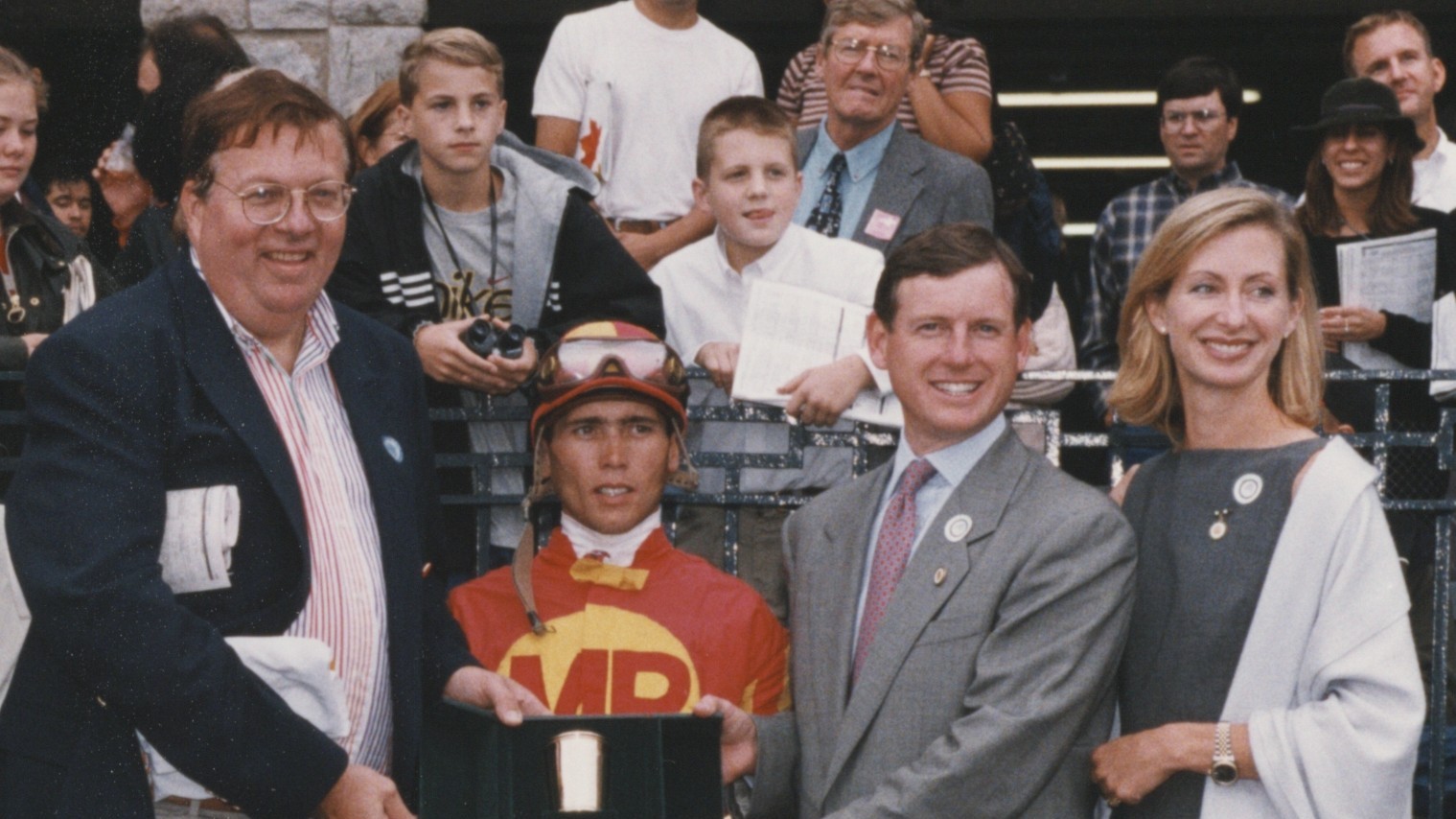
“I didn’t give up on standing him in Kentucky,” Pegram said. “Kentucky gave up on him. Apparently, sons of Fly So Free weren’t in much demand.”
As a result, America’s happy traveller found a home in a foreign land.
Pegram closed a stallion sale with the JRA for $5m and Captain Steve would be standing at Shizunai Stallion Station on the northern island of Japan.
After two prolific seasons, his opportunities dwindled.
The sons and daughters of Captain Steve proved to be little more than durable runners of modest ability.
“The sons and daughters of Captain Steve proved to be little more than durable runners of modest ability.”
He never sired a major Stakes winner, but there were more than a dozen offspring who had careers of more than 50 starts.
Captain Steve died on 21st April 2013 at Schichinohe Stallion Station at the northern tip of Japan’s main island of Honshu. He was 16.
As for the other Captain Steve, upon his retirement from the Louisville police department Thompson’s captain’s badge No. 53 was retired, an honour afforded to only one other individual at the time.
He came out of retirement to work for a while as head of security at Pegram’s Carson Valley Inn and Casino in Minden, Nevada, before heading back home to Kentucky and his collection of Captain Steve memorabilia.
“I’ve got so much stuff on him, everything you can imagine,” Thompson said. “But there’s nothing more valuable that my friendship with Mike and the honour he gave me with his horse.”
• Read all Jay Hovdey's features in his Favorite Racehorses series
‘The hot-blooded colt from Ireland’ – Jay Hovdey on In Excess
‘A devastating front-runner, calm and collected, and difficult to pass’ – Jay Hovdey on Little Mike
View the latest TRC Global Rankings for horses / jockeys / trainers / sires