

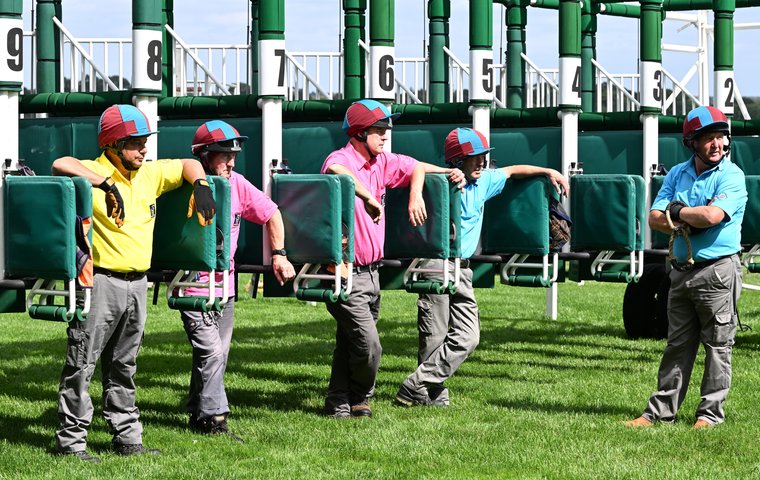
Chaotic tape starts have got both jump jockeys and spectators in a tizz. Perhaps it’s time to contemplate a radical alternative.
Another Cheltenham Festival and another bout of moaning over false starts.
They not only infuriate jockeys but, apparently, impatient spectators too.
If only there was a way of keeping ever runner in line and starting every race first time.
Well, there is.
They’re called starting stalls and they’ve been part of European Flat racing for more than half a century.
They’re also already used to start both hurdle races and steeplechases in such nations as Japan, Australia and New Zealand.
Jump racing, admittedly, isn’t particularly big business in those jurisdictions, quite unlike Britain, France and Ireland, Europe’s jumping powerhouses, where fixtures are plentiful and, in the last-named country, there are even more annual jump than Flat races.
Placing stalls across the often-soft turf of European racecourses would certainly necessitate a colossal change of approach for the region’s trainers, even if they were all required to adopt the same alteration in unison.
It would ask them not only to school their trainees in the art of jumping, but also in the discipline of restraining such coiled energy as is amassed in the anticipation that comes with waiting for the starting gate to open, jetting off with the modest pace required of races than can unfurl over four miles or further.
But if competitors down under and out east can manage – New Zealand’s stall-started Grand National Steeplechase, for instance, is run over 5600m – can European trainers be persuaded of a mechanical level break’s merits?
Writing for Horse & Hound, former jump jockey Davy Russell lamented starting big Cheltenham races on a bend, calling it wrong to expect “20-plus runners to come around a corner in a straight line”.
Russell also endorsed starters dropping the tape the moment competitors have formed a straight line, even if they’re “still a long way back”.
Similar calls have been made by such figures as Nick Alexander, until recently president of Britain’s National National Trainers Federation.
“Give the starters a bit more leeway so they can let them go when they see everyone coming forward in the right line,” Alexander told Racing TV. “Even if one of them happens to be cantering on the spot.”

But that surely isn’t sensible.
It has the unintended effect of increasing advertised distances and, even if mere yards are added, who’s to say such longer trips won’t impact races at their business ends?
Halfway through this year’s Festival, Britain’s racing authority, the BHA, said a full review of Cheltenham Festival starts would get underway when the meeting reached its conclusion, ready for adjustments to be made ahead of next year’s edition.
The review is to be completed in collaboration with the Jockey Club (Cheltenham’s owner), the Irish Jockeys Association (IJA), Britain’s Professional Jockeys Association (PJA) and the aforementioned NTF.
It arrives after several false starts at last year’s Festival led the BHA to discuss “contributing issues” with the Jockey Club and PJA, conversations that resulted in “measured alterations” to some starting locations in 2026.
But numerous jockeys at this year’s Festival have, like Russell, said beginning on bends is still an issue.
“It was the starts on the bends when there wasn’t as much space that were trickier,” top-tier rider Sam Twiston-Davies told the Racing Post.
“The two-and-a-half-mile start on the inside of the course was a shocker because we were coming around a bend and having to start 50 yards after that,” Ben Jones told the same publication.
Their colleague Johnny Burke did, however, tell the paper that though “a lot of the starts are on bends”, “it has been like that for years” and he wasn’t “saying that’s a problem.”
But could bends be a sticking point in this grand idea to bring starting gates to European jump races (and, come to think of it, why not American jump races while we’re at it?).
As Burke says, races have started on Cheltenham’s bends for years.
Compromise is to be encouraged, but considerable consternation could come from changing race complexions to accomodate contraptions, given that it could prove inadvisable to place stalls on turns, where loading or leaving could be rendered either challenging or dangerous.
Furthermore, should starting stalls be employed across jump racing in the Northern Hemisphere (dragging British and Irish stalls handlers off the all-weather and out of winter hibernation), they’d clearly need to enter use in major jumping jurisdictions simultaneously.
Britain and Ireland, that’s to say, which see the bulk of cross-pollination.
Difficulties from disparities between start methods in those jurisdictions have already been raised by jump jockeys.
Rolled out in tandem, though, starting stalls would eliminate such British/Irish discrepancies.
So, is it wrong to dismiss their introduction as an entirely ecentric, possibly insane, proposal?
Consideration of the benefits is surely not unreasonable.
Stalls would, after all, put everyone on a level playing field.
Who’s up for a barrier draw at Aintree?
Read of our inaugural Global Rankings Weekly Awards article
Shane McNally paid tribute to Makybe Diva, who died towards the end of last month
View the latest Global Rankings for horses, owners, breeders, trainers and jockeys