
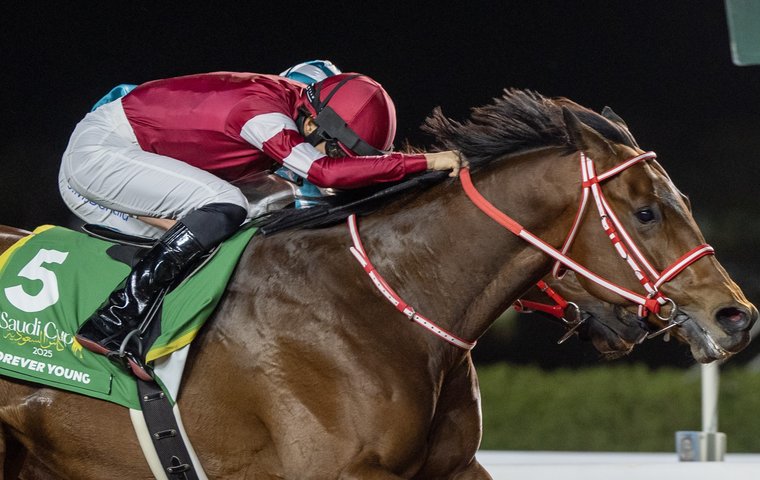
From a conditions race (albeit a rich one) to a Group 1. This weekend, the Saudi Cup has its fifth running as a top-level contest.
Few major races have had such notorious opening editions.
At the end of February 2020, weeks before a pandemic shut much of the world, the eyes of the world (well, the racing world at least) were on King Abdulaziz Racecourse and Maximum Security, who seemed to storm to success in the inaugural running of the 1800m Saudi Cup.
His connections looked set to pocket half the new contest’s $20m purse, money that put it – and still puts it – top of a list of the world’s richest races.
But the money was withheld.
Jason Servis, Maximum Security’s trainer, was indicted by US federal authorities the following month, charged with offences related to manufacturing, procuring, distributing and administering illegal substances to horses.
Just over two years later, he accepted a plea deal related to new charges and was sent down for four years. Maximum Security was disqualified and every runner behind him elevated one place. Midnight Bisou was declared the new winner.
Purse and Pattern aren’t, of course, mutually dependent. Money talks. The chance of winning the non-black type A$10m Golden Eagle must be just as alluring as the opportunity of bagging a Group 1 with a smaller prize pot. Not least if you’ve a gelding on your hands.
“Money talks. The chance of winning the non-black type A$10m Golden Eagle must be just as alluring as the opportunity of bagging a Group 1 with a smaller prize pot. Not least if you’ve a gelding on your hands.”
When 11 runners from four continents left the stalls for the Dubai World Cup debut, they were racing only at Listed level. It wasn’t Pattern prestige but the multi-million-dollar prize (as well as, one hopes, the opportunity to be part of something fresh and global) that had drawn their connections to Nad Al Sheba.
That said, Pattern recognition surely helps.
Picking up the Pattern
In 2022, the Saudi Cup didn’t pass go, taking Group 1 classification from that third running onwards. For the Bahrain International Trophy, another much-advertised global Middle Eastern ‘destination’ event for owners and trainers, the journey has been slower.
Like the Saudi Cup, that prize had to make do with conditions status for its first two editions. It progressed to Group 3 level in 2021 and to its current Group 2 status in 2023.
You’d expect The HH Amir Trophy, which also runs tomorrow, just over the border from the Saudi Cup in Qatar and with a total pot of $2.5m, to also be in search of internationally-recognised Group 1 status.
The race certainly has an international field, with three runners from Japan, plus France’s Goliath, Marco Botti’s Giavellotto, the Gosdens’ Lion’s Pride and Godolphin’s El Cordobes.
For its part, despite being less than a decade old, the Saudi Cup’s roll of honour already includes winners trained in Japan (twice), the USA (twice too), Britain and Saudi Arabia.
This year it features participation from Japan and America, along with native competition. European trainers have opted for the same card’s Howden-sponsored Neom Turf Cup, which will be run as a Group 1 for the first time.
Subsequent stallion status
Bob Baffert, speaking to the Nick Luck Daily podcast on Tuesday, said he thought the Saudi Cup “makes horses more valuable”, explaining that “everyone wants an American dirt horse, even though I got beat by a turf horse one year.”
That winner, of course, was Mishriff, victorious in 2021 and now commanding a €12,500 fee under the Sumbe banner in France.
Among fellow Saudi Cup winners, he’s pipped in stud fees only by Panthalassa, the 2023 hero, who stands in Japan for ¥3,000,000 (the equivalent of roughly €16,500).
Emblem Road, however, who won in 2022 – the first Group 1 running – is a gelding and Senor Buscador, the 2024 winner, is just $7,500 a pop. Maximum Security stands for only $3,500 in Indiana.
Those far from remarkable figures are, however, until we consider the mare Midnight Bisou, a $5m Chuck Allen purchase at Fasig-Tipton in the year of her retroactive Riyadh triumph and a $5.5m Katsumi Yoshida buy at Keeneland two years later when offered in foal to Tapit.
The only one on the winners’ list to have past the post second has, it seems, so far emerged in many ways most valuable.
The page before purchasers at Keeneland and Fasig told only of her numerous native triumphs and her 2019 American Champion Dirt Female Horse title.
The Saudi Cup had been a conditions race in 2020 and, not yet promoted to first place, she was merely its runner-up on the page. The run was a footnote.
One doubts it’ll be a footnote for tomorrow’s winner.
Nick Luck spoke to Kyoto Maekawa, the JRA’s first female licensed trainer, on the Nick Luck Daily
Bob Baffert, who runs two in the Saudi Cup, also spoke on Luck’s podcast
View the latest Global Rankings for horses, owners, breeders, trainers and jockeys