

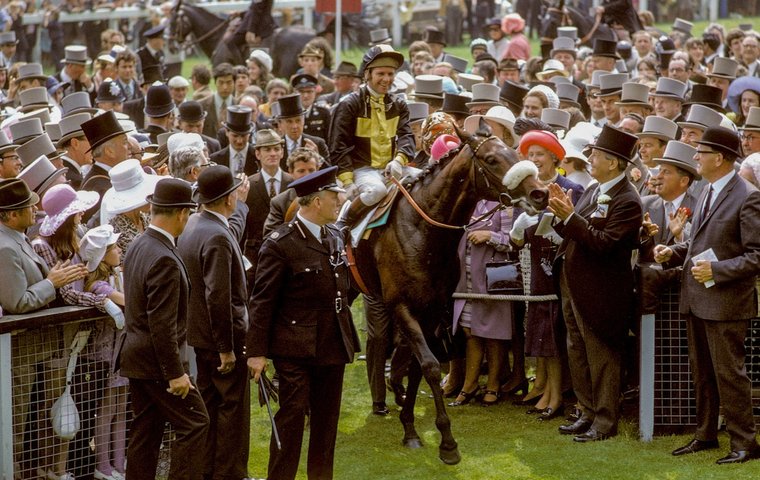
With the recent passing of trainer Ian Balding, the final link to one of the greatest horses of all-time was broken. Steve Dennis looks back on the career of Mill Reef and those closest to him
 All things must pass; sometimes we lose something of ourselves in that passing. With one hand we wave farewell, the process of letting go, but with the other we hold tightly to what we can keep, that we can never lose, the essence, the spirit, the memory.
The death of master trainer Ian Balding on January 2, at the age of 87, has snapped the final link in the story of one of the greatest horses there has ever been, the virtually incomparable Mill Reef, whose triumphal procession through the biggest middle-distance races in Europe in 1971 left an impression that has been reinforced rather than reduced by the usual minor cruelties of time.
Mill Reef was the winner of the Derby, the Eclipse Stakes, the King George VI and Queen Elizabeth Stakes and the Prix de l’Arc de Triomphe – all by daylight margins.
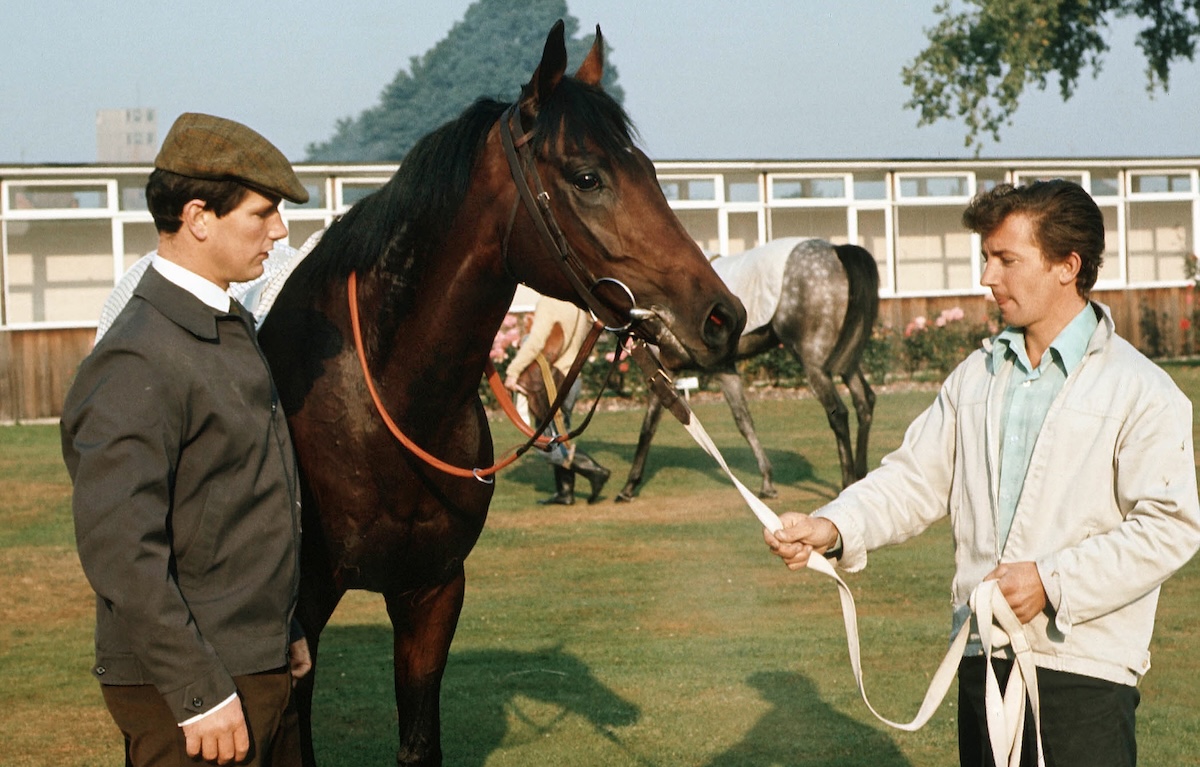 He gave the slightly unreconstructed Balding – memorably described by the Daily Telegraph as possessing the glamour of a fighter pilot and the tact of an untrained gorilla – his only British Classic success and his sole trainers’ championship.
Theirs is a legacy that can never fade, the pair of them heroes of a summer that defies the laws of physics, radiating all its original warmth even as it recedes ever further into the past.
Of course there were many other celebrated names and shining hours among Balding’s haul of 1,755 winners in a 38-year career, notably Silly Season, a mercurial sort who would have won four Group 1s had the Pattern been in operation in the mid-1960s; champion juvenile fillies Mrs Penny and Forest Flower, who parlayed precocity into Classic glory in the Prix de Diane and Irish 1,000 Guineas respectively; six-time G1 winner Glint Of Gold; the majestic handicaps-to-Group 1s champion sprinter Lochsong; and Cheltenham Festival winner Crystal Spirit.
But none of Balding’s other stable stars came close – how could they? – to the magnitude of the little US-bred colt, whose Timeform rating of 141 is the fifth-highest ever awarded, of whom the garlanded jockey-journalist John Oaksey wrote, possibly understating the case: “In just three years of cheerful service, Mill Reef gave more pleasure and excitement than most men generate in a lifetime.”
Mill Reef, a son of Never Bend bred by his philanthropist American owner Paul Mellon, was cut out for greatness from the start. Among a historically outstanding crop of two-year-olds Mill Reef excelled, with his ten-length victory in the Gimcrack Stakes at York, run in a quagmire, the most memorable for its circumstance.
“The Gimcrack is one that stands out for me because I didn’t want to run him on that ground,” said Balding. “Thank God that Paul Mellon was there and made the decision to run, saying that he had a funny feeling that everything would be all right. And it was; it was extraordinary.”
A Guineas with no equal
His first big target at three was the 2,000 Guineas, for which he was favourite. At the time it appeared an exceptionally strong edition of the race, and in hindsight it has no equal. Mill Reef was beaten into second place by the equally outstanding Brigadier Gerard, two of the greatest champions in the history of the sport remarkably foaled in the same year.
The ‘Brigadier’ was the better miler, although he would stay further in time, so here their paths diverged. Brigadier Gerard went unbeaten through the rest of the year and Mill Reef was never beaten again, carrying to eternal fame those quirky, era-defining black silks with a gold cross, cuffs, and stripe on the cap that his Anglophile owner employed in Europe. Oh, to be alive in such a summer, when miracles were everywhere.
Balding called that Newmarket defeat “one of the biggest disappointments of my life”, quoted in the anthology My Greatest Training Triumph, and it was certainly a body blow to all at the Kingsclere yard, but in the event it was no more than a prelude to sporting immortality.
Mill Reef then went to Epsom for the Derby, moved up to a mile and a half in one bound, but had an easier time of it on the big day than did Balding, who had to run the last two miles (in top hat and tails) to the racecourse owing to a traffic snarl-up. He got there in time to saddle Mill Reef, complete with his ever-present white sheepskin noseband, and watch him cruise to a straightforward two-length victory in the hands of Geoff Lewis, who rode him in all his races.
 Lewis, who died in August 2025 at the age of 89, was considered one of the best jockeys never to be champion in the UK, an effervescent little Welshman whose background could not have been more different from those of the well-to-do Balding and the fabulously wealthy Mellon. Lewis was the sixth of 13 children, his father was a labourer, and his first job was as a pageboy at the Waldorf Hotel in London.
Eerie prescience
Yet in the saddle there were few better, and Lewis was aware of Mill Reef’s brilliance from the outset. After the colt’s debut success he told Balding, with an eerie prescience, that “this is for sure the best horse you have had, and I rather suspect he might be the best horse you will ever have”.
Lewis was thoroughly dedicated to Mill Reef, ensuring that there was a clause in his contract with trainer Noel Murless that allowed him to ride the colt whenever he ran. He also gave up alcohol and cigarettes for ten days before each of Mill Reef’s big races to intensify his focus; sport (and life) was different then.
“To win the Derby was the pinnacle of my career,” he told journalist Claude Duval in a contemporary interview.
“I was extremely confident and felt that I only had to avoid trouble in the race to be the winner. I took a sleeping pill the night before the race and only a bomb would have woken me up. When you achieve moments like this you just want to get off and bite the horse – you really love him.”
That love affair with Mill Reef – minus the love-bites, perhaps – shared by Lewis and the British racing public continued through the Eclipse at Sandown, which Mill Reef won by four lengths in track-record time, and the King George at Ascot, six lengths eased right down.
Time for celebration
Every day Mill Reef went to the racecourse was a time for celebration, the sense of being lucky enough to witness something extraordinary, the little horse with the light, athletic, thrillingly fluid gait that made it seem as though he simply floated over the ground.
“He had the most wonderful temperament and was an absolute delight,” said Balding. “I can’t remember a Thoroughbred colt being so gentle and sensible.
As summer slipped resignedly into autumn’s crisp embrace, the Prix de l’Arc de Triomphe was chosen for Mill Reef’s final race of the year. Mellon pulled strings Stateside to enable the raiding party to fly to Paris from the American airbase at nearby Greenham Common, and a horde of British racegoers followed them to Longchamp in slightly less palatial fashion. They all seemed to be wearing lapel badges in Mellon’s colours, a branding exercise far ahead of its time.
No British-trained horse had won the Arc for more than 20 years, but Mill Reef cantered to post amid an atmosphere of fervent hope and barely stifled expectation and galloped back in his usual majestic manner, surging through a gap near the rail a furlong and a half out and sprinting away for a three-length score and another track record.
Unremitting lustre
It was the perfect end to a near-perfect season, an unforgettable campaign of unremitting lustre that earned him, rather than his Newmarket conqueror Brigadier Gerard, the title of European Horse of the Year.
 “There was just something different about Mill Reef,” said Lewis, reminiscing in his old age. “He always seemed to do the right thing at the right time. All I had to do was point him the right way and not fall off.”
Mill Reef won both his races as a four-year-old but broke a foreleg on the gallops while being prepared for the Arc. He was operated on in what is now the Kingsclere colours room, spent six weeks in plaster and was saved for stud, where he sired Derby winners Shirley Heights and Reference Point as well as Lashkari, winner of the inaugural Breeders’ Cup Turf.
“Over the years, I’ve bred some very good horses,” said Mellon, in reflective mood. “But a hundred years from now, the only place my name will turn up anywhere will be in the stud book, for I was the breeder of Mill Reef.”
With Balding’s death, the guardians of that glorious summer are all gone. Lewis died last year, Mellon in 1999, Mill Reef in 1986. The golden thread has not been lost, though; Balding’s son Andrew trains very successfully from the same yard, and Mellon’s famous silks – bequeathed to his trainer – are still carried by horses owned by the Kingsclere Racing Club.
A documentary was made about Mill Reef during his four-year-old campaign, cinematic record of his career and recovery from injury. It was called Something To Brighten The Morning, a fitting title but insufficient in scope; Mill Reef was not just for the morning but for all time.
All things must pass, but good things never die, like the memories as sunlight bright as the broad gold stripe on Geoff Lewis’s cap.
• Read previous articles in the View From The Rail series
Nancy Sexton: The world’s ten most expensive sires for 2026
Staying power: Tracing the enduring Horse of the Year connection to Secretariat’s name
Two horses, one name – Steve Dennis with a sideways look at Coolmore’s past and present
View the latest TRC Global Rankings for horses / jockeys / trainers / sires