

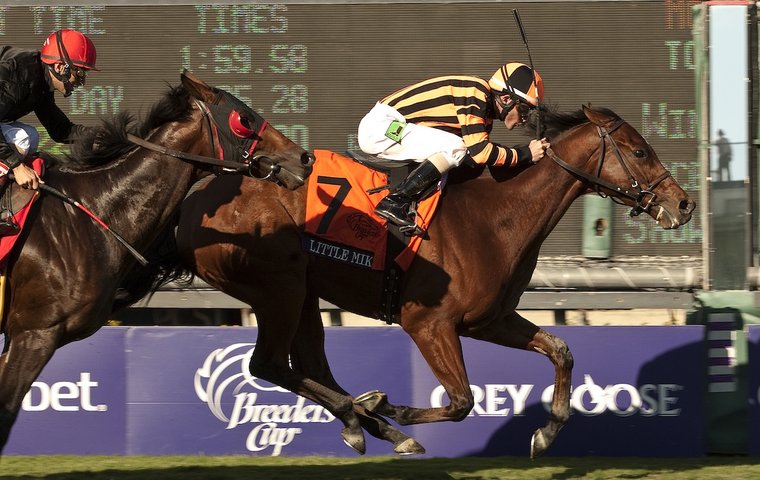
‘The son of a rescued mare and a stallion secured with a few bucks and a handshake’ – our series continues with an unlikely Breeders’ Cup hero who belied humble antecedents
 Behold a surefire recipe for a racehorse story almost too wild to believe:
Start with a breeder, owner, and restaurateur who shared his love of the sport with everyone he knew.
Take a broodmare he rescued at the last minute from a one-way trip to the slaughterhouse.
Add an obscure stallion whose services were secured with pocket money and a steak dinner.
Season with a namesake who was barely as tall as some of the winning trophies, a champion trainer who later in life would make a run at national political office, and a Hall of Fame jockey who suffered injuries that forced his retirement while at the pinnacle of the game.
 And for a poignant flourish, include his human connections among the growing list of families whose children have experienced the horrors of a school shooting.
Now shake well, then pour the heady concoction into a stout-hearted bay gelding who raced far and wide to win $3.5 million, along with the lasting admiration of the thousands of fans who were lucky enough to see him in action.
Call him by his name – Little Mike.
The tale begins some time in the last half of 2002. Carlo Vaccarezza had moved from New York to Chicago to open an olive oil processing plant. To that point, his business had been primarily as a restaurant owner, which included a Manhattan establishment frequented by local celebrities of varying reputations. But horse racing was a close second.
While in the Midwest, he was advising his friend, Pat Greco, on the dispersal of about 40 Thoroughbred mares located at a farm near the town of St. Charles, east of Chicago. Greco, a leading distributor of Italian food, had dreamed of reviving the Illinois breeding industry, but his plans fell through. Vaccarezza stepped in to make sure the mares went to proper farms instead of a killer pen located just across the state line in Missouri.
“I would jump in the golf cart and head to the fields, and there was this one mare who would always follow me,” Vaccarezza said. “Her name was Hay Jude.
 “She was one of two mares left,” he continued. “We couldn’t give them away. One day I got to the farm and there was a broken-down trailer hooked to a ’68 Ford pickup with Missouri license plates.
Narrow escape
“Hay Jude was being loaded onto the trailer. I asked where she was going, and he said the mare was for his daughter. But the more questions I asked, the more he was lying to me.”
Vaccarezza called him out, peeled off $300 from a roll in his pocket and said: “Here’s for your trouble. You’re not taking the mares.”
The other mare went home with Tom Swearingen, who confirmed that Vaccarezza had just saved two lives. Swearingen had trained Hay Jude throughout her career of 30 starts at Chicago-area tracks.
The daughter of Haskell Invitational winner Wavering Monarch had done nothing more than win a couple of allowance races at Hawthorne, and there were precious few highlights in a female family that traced back to blue-collar British mares. Then again, what do you want for $300?
Vaccarezza sent Hay Jude to Ocala, Florida, where she bounced around a few farms before landing with Dr. Jean White, a respected local veterinarian. Hay Jude’s first foal, by the Storm Cat stallion Lake Austin, never raced.
She next went Tiger Ridge, another son of Storm Cat, and got a colt who was handsome enough to be named for the owner’s oldest son, Nicholas.
Once Little Nick was a healthy, happy foal, Hay Jude was bred in 2005 to Unbridled Time, a pricey yearling and a stakes winner for Wayne Lukas. Later that year, Vaccarezza was driving through the hinterlands of Central Florida, on the trail of a promising mare he hoped to acquire.
Middle of nowhere
“I got lost,” Vaccarezza said. “I ended up in the middle of nowhere. Dirt roads. I see nobody, and it’s starting to get dark. I finally saw a person standing by a fence.”
 The man at the fence was farm owner Eddie Martin, who informed Vaccarezza that he was about 30 miles in the wrong direction, and that if he could wait until he brought a horse in from the field he would get in his truck and he would get the traveler back on the right path.
“The horse he was bringing in was named Spanish Steps,” Vaccarezza said. “I never saw such a beautiful horse in my life. He was a full-brother to Unbridled’s Song who got hurt and never raced, and he was named for one of the most famous places in my native Italy.”
In that first season at Martin Stables South, the four-year-old Spanish Steps served an overflow book of mares, and Martin was determined to do the same in 2006.
Vaccarezza was grateful to Martin for leading him back to civilization and the shelter of an accommodating Hilton hotel. In gratitude, Vaccarezza invited his rescuer to dinner at a nearby Outback Steak House. One thing led to another, and after Vaccarezza expressed a desire to send Hay Jude to Spanish Steps, Martin agreed, for a token gesture of $250 and a handshake.
Back in Florida, when J.J. Crupi got wind of Vaccarezza’s adventure he had to laugh. The noted Ocala breeder and bloodstock agent was the proprietor of New Castle Farm, as well as Carlo’s good friend and fellow Italian. He declared that Vaccarezza had been hustled out of his two-fifty, and that when he showed up in the spring to breed Hay Jude, there would be no stallion to be found.
“I told him, ‘If I’m gonna get screwed, so be it … $250 is not going to change my life,’” Vaccarez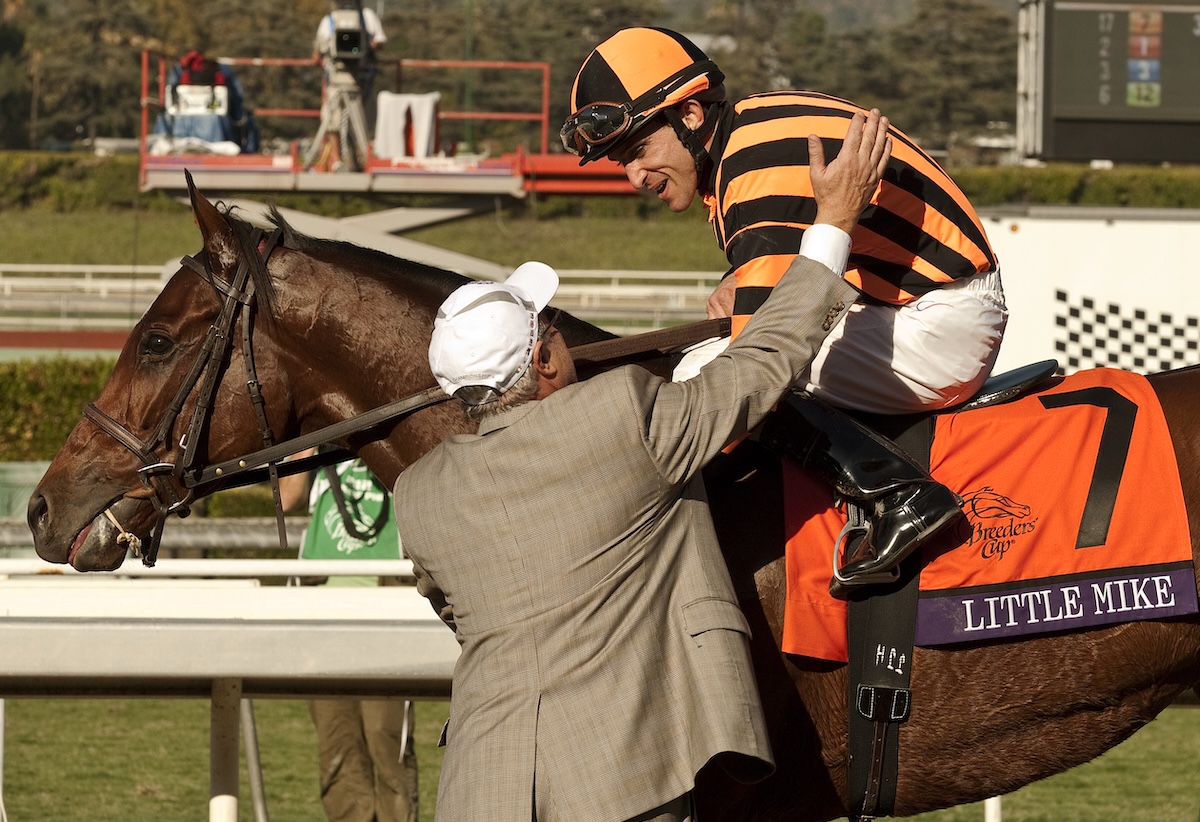 za said. “When she was ready to be bred, we put her on a van and took her to the farm, where we were welcomed with open arms. Spanish Steps covered the mare – and that was Little Mike.”
Hay Jude’s foal of 2007 was born on May 24, near the tail-end of a North American foal crop that numbered 37,499. He was not destined to be a big fellow, but he had plenty of leg for his size and attractive balance to go along with the small white star on his forehead.
“Crupi broke him and started to breeze him,” Vaccarezza said. “He would tell me, ‘This horse is waking up and doing good.’”
Precocious enough
By the summer of 2009, it was time to test the waters. Little Mike went into the barn of South Florida veteran William White, and he was precocious enough to debut with a solid second that July in a smart Calder maiden race, on the same program Little Nick took a sprint stakes on the turf.
However, Little Mike sustained a minor injury in a subsequent stakes try and went to the sidelines for the rest of the year.
The following summer, Little Mike returned to the races at Monmouth Park under the care of Allen Iwinski. After two more straight maiden race losses, both in dirt sprints, Iwinski suggested that it might be time to consider a $25,000 maiden claimer.
“His rider, Paco Lopez, was there next to me,” Vaccarezza said. “He said, ‘Boss, don’t do it. Put him long on the turf. This horse is not gonna get beat.’”
 They found just such a race on Aug. 28, 2010. As luck would have it, though, Lopez was handed a suspension for fighting with fellow jockey Joe Bravo, forcing Vaccarezza to come up with a last-minute replacement. And look who was available – Joe Bravo.
Devastating front-runner
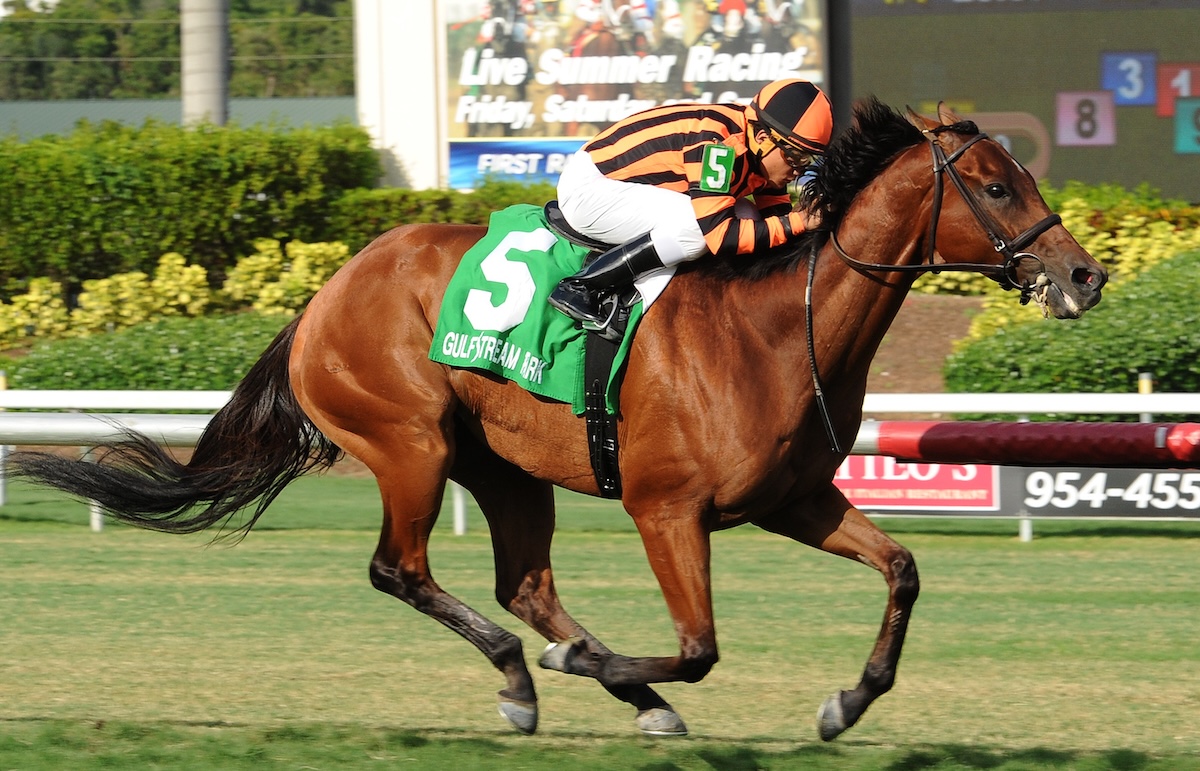
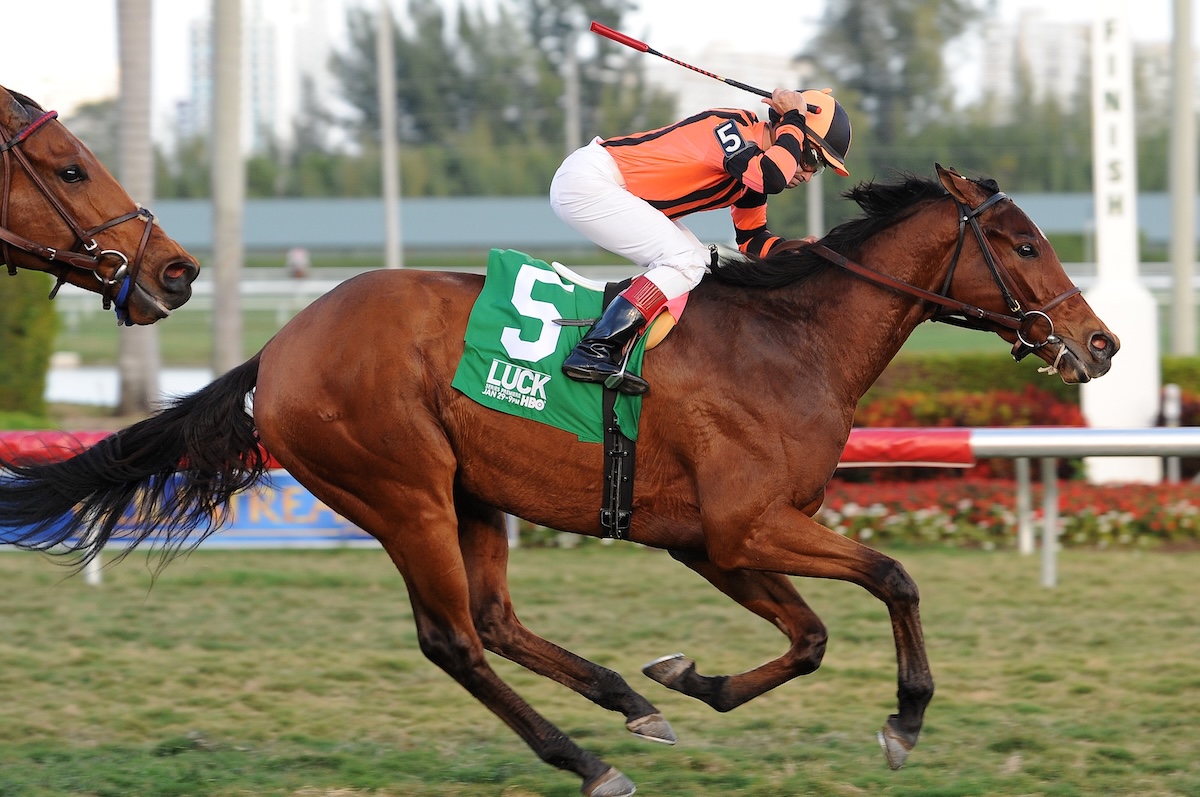
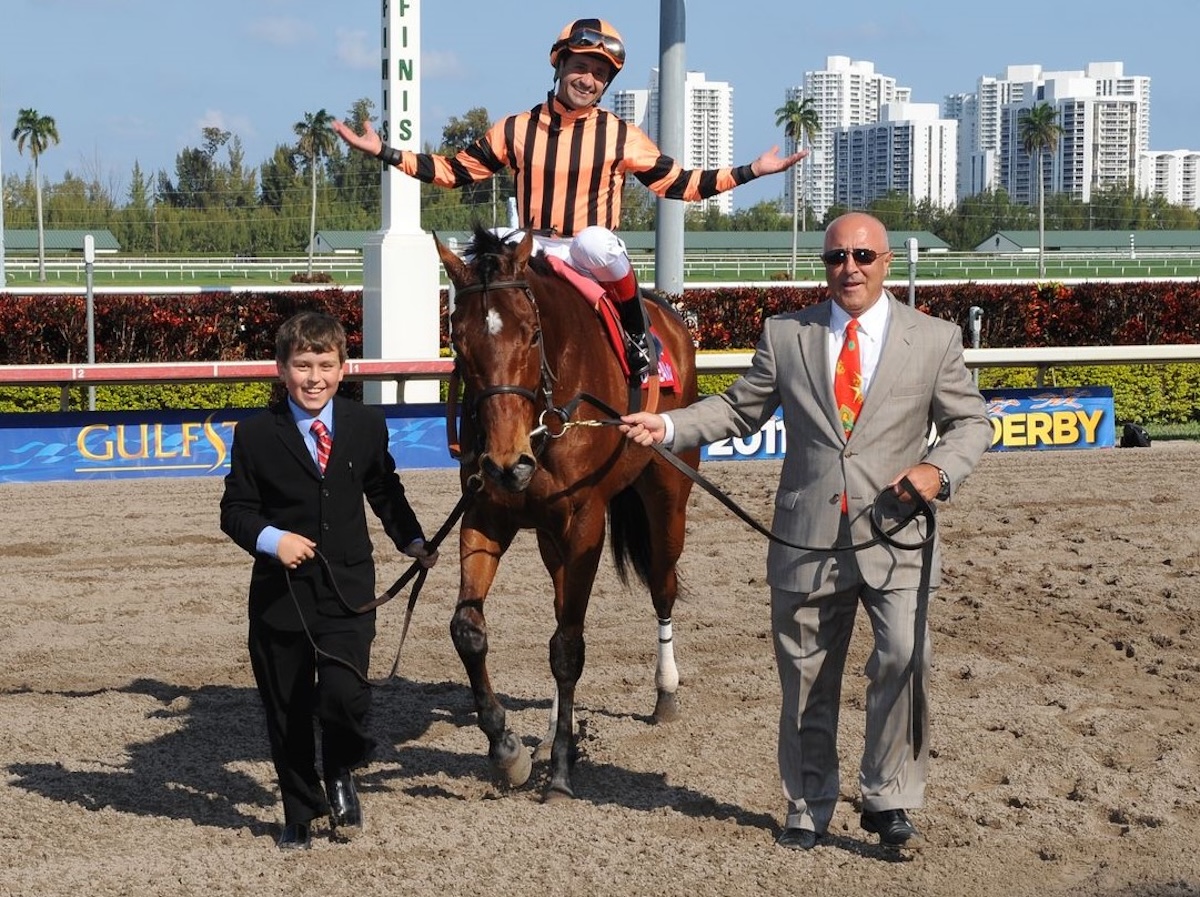
Over the ensuing 22 months, ranging well into 2012, Little Mike and Bravo teamed for 14 grass races and 10 victories. Racing in the name of Priscilla Vaccarezza, Carlo’s wife, the gelding had developed into a devastating front-runner, calm and collected, and difficult to pass.
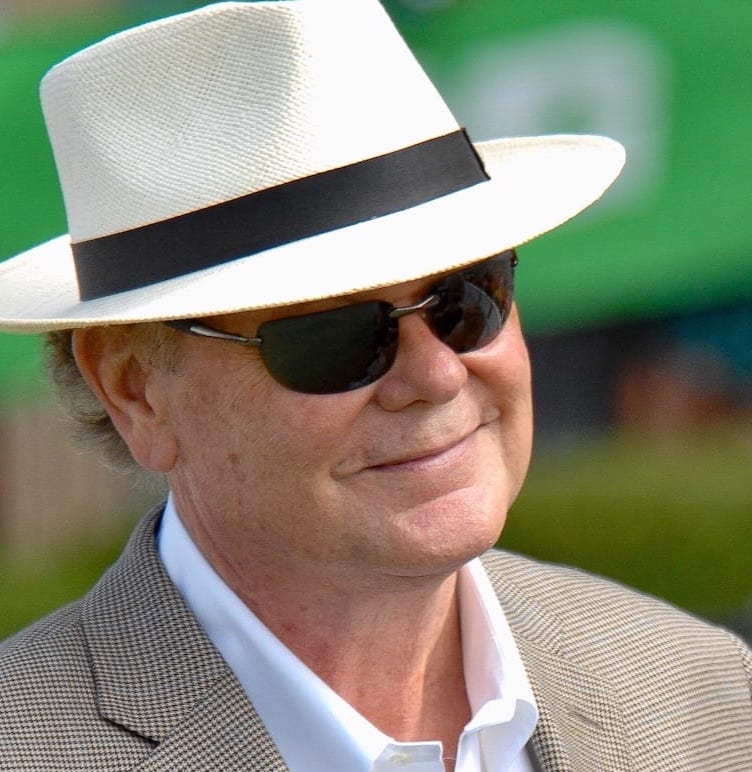
After winning the G3 Ft. Lauderdale Handicap in January 2011, Little Mike was moved to the care of Dale Romans (right), whose public stable was led at the time by the turf ace Paddy O’Prado. Little Mike never missed a beat.
“He was getting so good,” Vaccarezza said. “If you let him loose on the lead, Little Mike is going to bury you. If the pace is fast, he’s gonna come and get you.”
Little Mike seized the G1 spotlight in the 2012 Woodford Reserve Turf Classic on Kentucky Derby day at Churchill Downs. Facing a field that included defending champ Get Stormy and Breeders’ Cup Mile runner-up Turallure, Little Mike led 10 opponents on a frustrating chase through nine furlongs to win by 2½ lengths at odds of 12-1. A star was definitely born.
After a trip to California and a third-placed finish in the Shoemaker Mile over a Hollywood Park turf course rarely kind to committed front-runners, Little Mike returned to the Romans stable at Churchill Downs to prepare for the Arlington Million, still considered one of the great prizes of the American turf.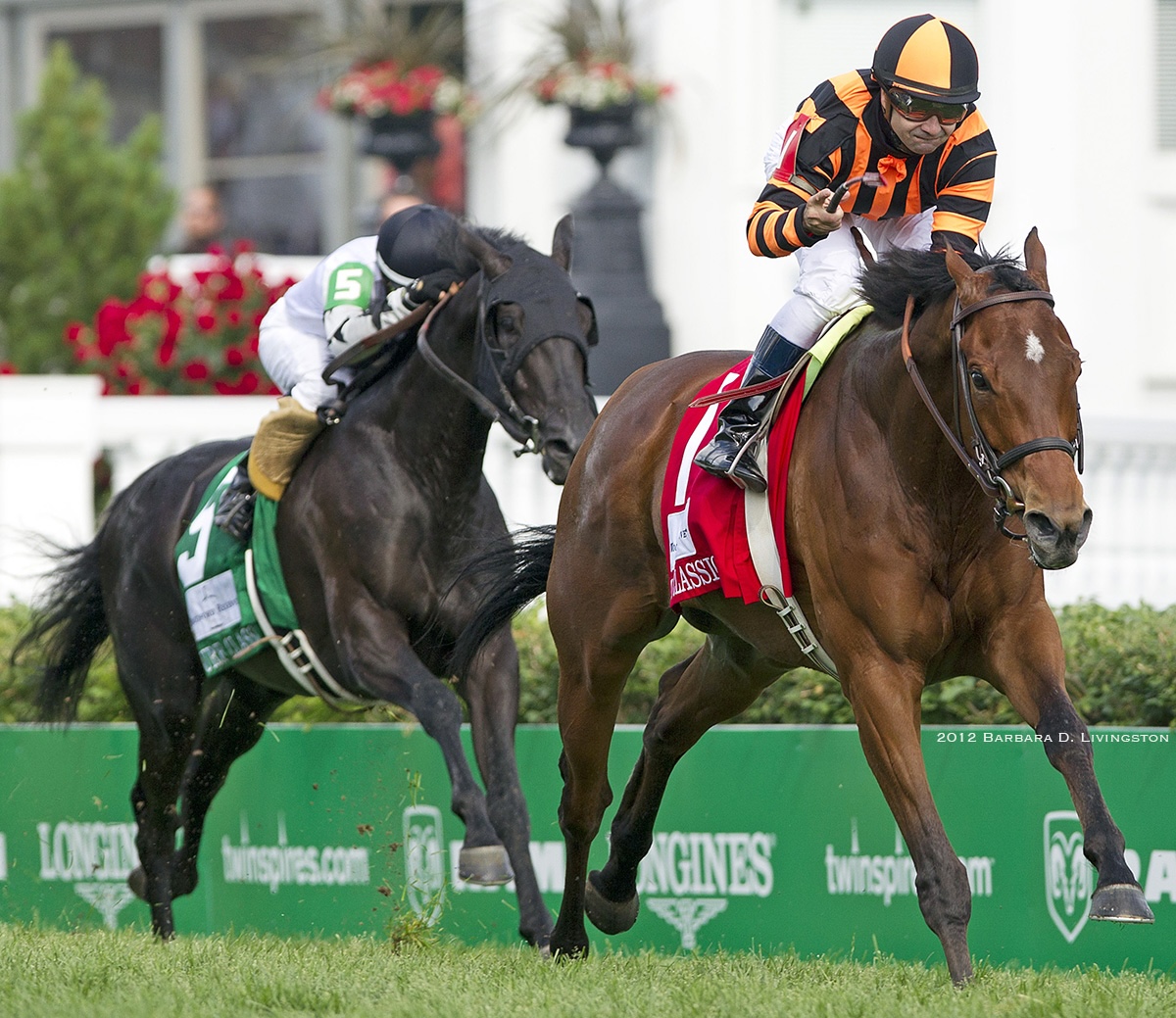
Last-minute booking
“Just before the entries, I hear from Bravo’s agent that he is staying at Saratoga that day to ride Turbo Compressor in the Sword Dancer for Todd Pletcher,” Vaccarezza said. “I can’t believe it. Who can I get at the last minute? I took a chance and called Steve Rushing, the agent of Ramon Dominguez.”
At the time, Dominguez was on his way to a third straight Eclipse Award at the nation’s outstanding rider. Chances were remote that he might be open for a race like the Million. But he was.
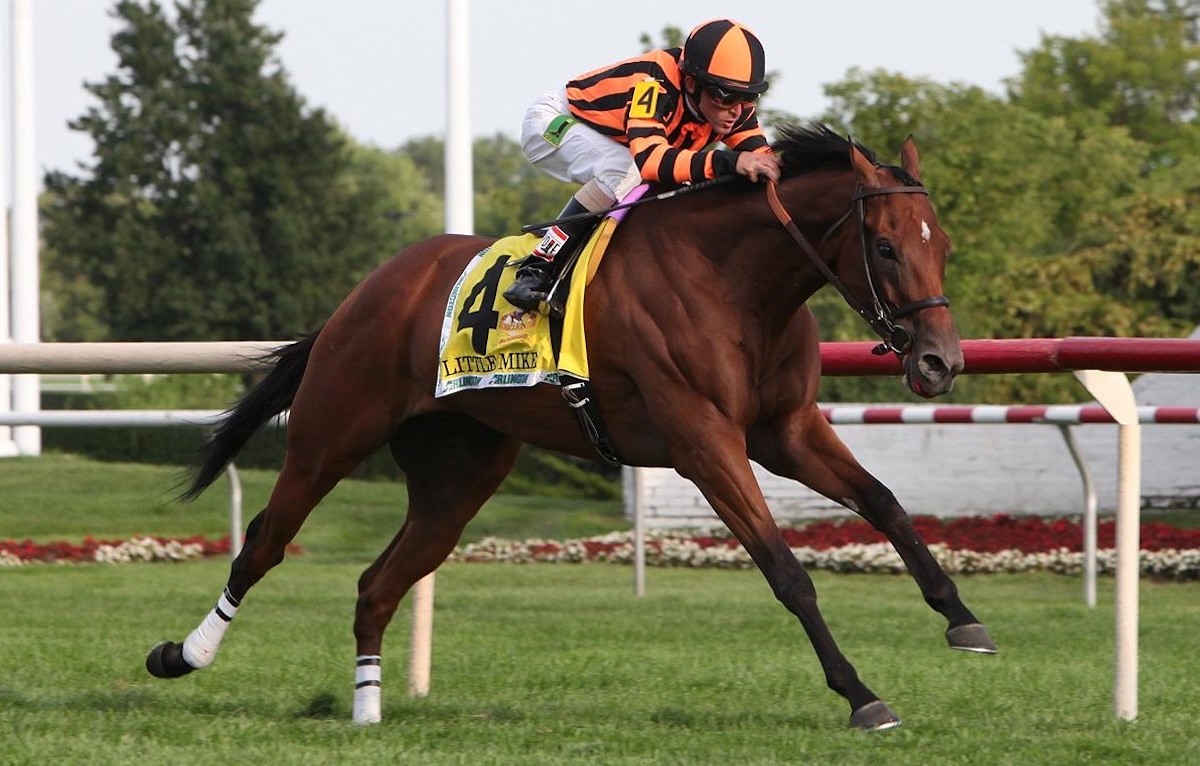
Facing a field that included European invaders from such heavyweight trainers as Aidan O’Brien, John Gosden, Luca Cumani and Marco Botti, Little Mike popped out of the gate like a jackrabbit and led the field through a sauntering first quarter-mile past the stands.
Dominguez kept his hands low and light pressure on the bit, leaving his horse to lob along at a relentless rhythm. The opposition never got closer than Little Mike’s tail. He opened a five-length lead in mid-stretch, then coasted to the finish, adding a couple of flying lead changes as Dominguez geared him down to win by a length and a half.
“Mike Ditka was there to present the trophy,” said Vaccarezza, referring to the Chicago football legend. “The trophy was as tall as Michael. As Ditka presented it he said, ‘From Big Mike to Little Mike!’ The crowd went crazy.”
 Meanwhile, at Saratoga, Bravo had finished last in the Sword Dancer with Turbo Compressor. After watching the telecast from Arlington, the rider sent Vaccarezza a congratulatory text accompanied by a request to get his horse back. Not surprisingly, the owner stuck with Dominguez.
Alas, the Belmont Park turf was yielding for the Joe Hirsch Turf Classic, and Little Mike’s lilting stride over firm courses was compromised. Even at a slow pace, he could not maintain his rhythm and faded to fifth, far behind Point Of Entry’s sluggish time of 2:33.73 for the mile and a half.
Sunshine and quick ground
There would be nothing but sunshine and quick ground in California, though, when the best of the breed convened for the 2012 Breeders’ Cup at Santa Anita.
With Wise Dan heading for the Mile, Vaccarezza felt his horse had a better shot in the Turf, despite the fact that proven 12-furlong runners would be coming from all corners of the racing universe.
Point Of Entry would be there, and so would St Nicholas Abbey, winner of the 2011 Turf, also at Santa Anita. Stir in Shareta, winner of the Yorkshire Oaks and Prix Vermeille, as well as the Japanese contender Trailblazer, and it was clear Little Mike would need to run the best race of his career.
So he did, under a masterful piece of work by Dominguez, who had come to understand how versatile Little Mike could be.
“The plan was for us to go to the lead,” Dominguez said recently. “That was the logical thing to do. Why reinvent the wheel? But I wasn’t the only one with that plan, and when I went for the lead that position was taken.”
Taken, in fact, by Joe Bravo on Turbo Compressor. “So I had to take a hold of my horse and hope he would relax, which he did,” Dominguez went on.
Extremely happy
“I was extremely happy with the way he felt underneath me. I also knew that he would be facing an extra half-mile than he was used to, against the best horses in the world.”
With three furlongs to run, Little Mike was still cruising along in third, snug on the rail. Then, as they made the final turn into the stretch, Dominguez angled to the outside of Turbo Compressor and made his move. As Trailblazer, St Nicholas Abbey and Point Of Entry launched their runs, Little Mike had stolen a couple of clear lengths. They all came running in the final yards, but in vain.
“Turning for home, I knew that I had saved horse,” Dominguez said. “But in a race like that you don’t really know until it’s time to go. When I asked him to go, he gave me a great response. I was so so excited when he crossed the line first.”
Little Mike – the son of a rescued mare and a stallion secured with a few bucks and a handshake – had won the Breeders’ Cup Turf. Given all that, his odds of 17-1 seemed low.
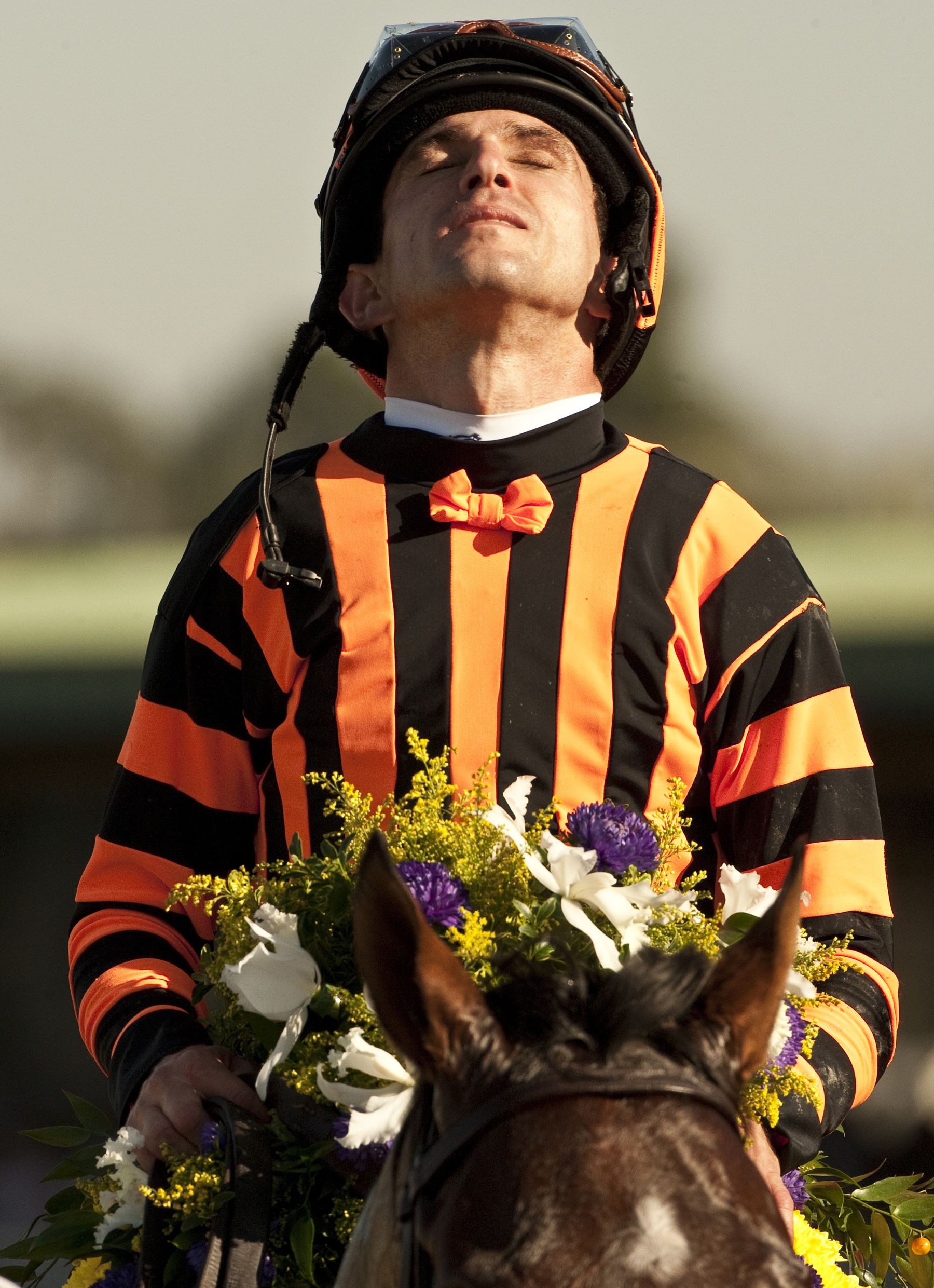 At the Eclipse Award the following January, Little Mike had to take a backseat to Wise Dan in the polling for both champion male turf horse and Horse of the Year. Little Mike played a major role, however, is securing the Eclipse Award as outstanding trainer for Romans, who has more recently made news with his decision to campaign for the US Senate from his home state of Kentucky.
As for Vaccarezza, he turned the page and sought new worlds to conquer, beginning with a two-race mini-campaign in Dubai in quest of the 2013 Dubai Duty Free. Unfortunately, Little Mike ran poorly in both appearances.
“He wasn’t the same Little Mike in Dubai,” Vaccarezza said. “He never really got acclimated. And then toll the trip took on him to come back was tremendous.”
Premature retirement
He also lost his jockey. In January of 2013, Dominguez suffered a fractured skull and a variety of other injuries in a terrible accident at Aqueduct in New York. When warned that another fall would be fatal, he retired, at age 36, with 4,975 winners.
It was not until September 2013 that the old Little Mike reared his head again. The setting was another crack at the Joe Hirsch Turf Classic, this time over a firm Belmont turf course. Owner Ken Ramsey had two legitimate contenders – Real Solution and Big Blue Kitten – but for good measure he entered a third horse, a hopeless longshot named Joe’s Blazing Aaron, just to pester Little Mike on the pace.
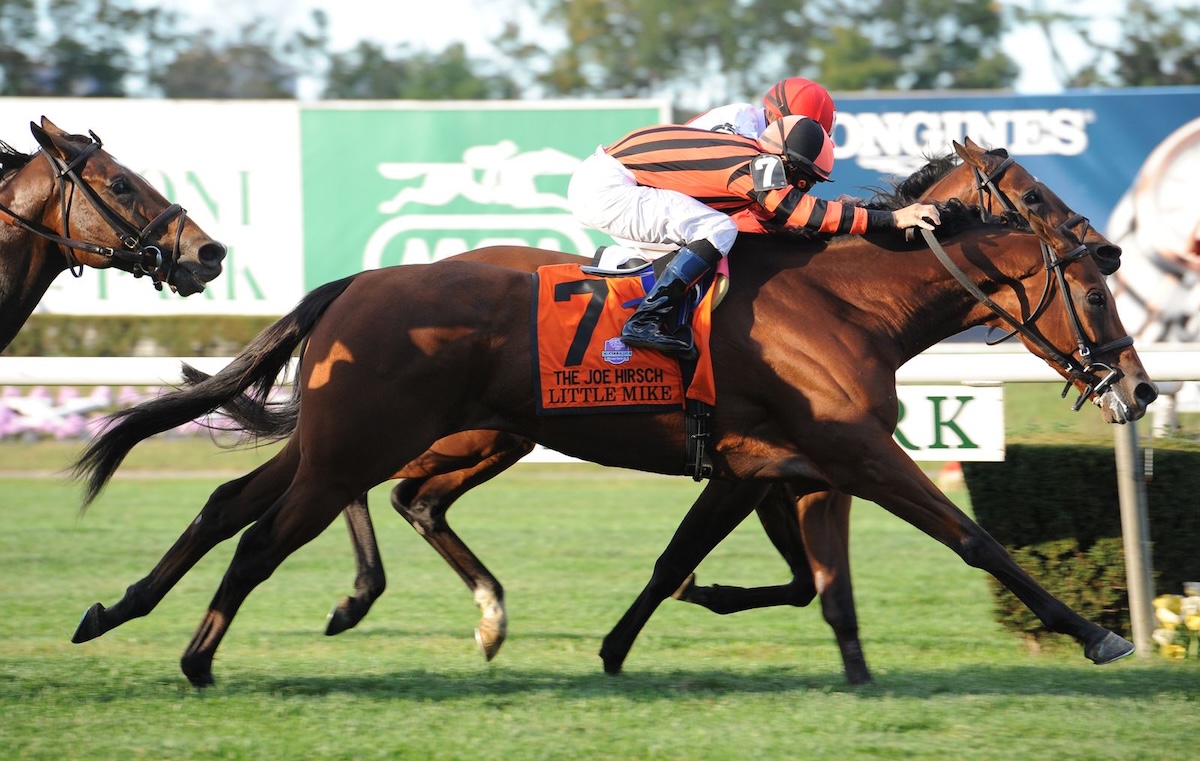 As he’d done in the Breeders’ Cup, Little Mike rated kindly, this time for Mike Smith, and finished with gusto to defeat Big Blue Kitten, ridden by Joe Bravo, by a nose. Real Solution was third, while the Ramsey pacemaker finished last. The final time was almost nine seconds faster than the 2012 running.
“It was three against one, and he beat them anyway,” Vaccarezza said.
The Hirsch was Little Mike’s last hurrah at the top of the game. His people took him to Hong Kong, where he was greeted as an international star. But he could do no better than ninth in the Hong Kong Cup.
Little Mike returned the following spring at age seven to win a small stakes at Gulfstream Park with predictable ease, after which a tendon injury sent him into what looked like a permanent retirement.
No expense spared
Vaccarezza spared no expense, though, in trying to rehabilitate the tendon. On July 10, 2016 – exactly nine years after his debut – Little Mike took the early lead in an allowance race at Gulfstream Park, then gracefully bowed out to finish five lengths behind the winner.
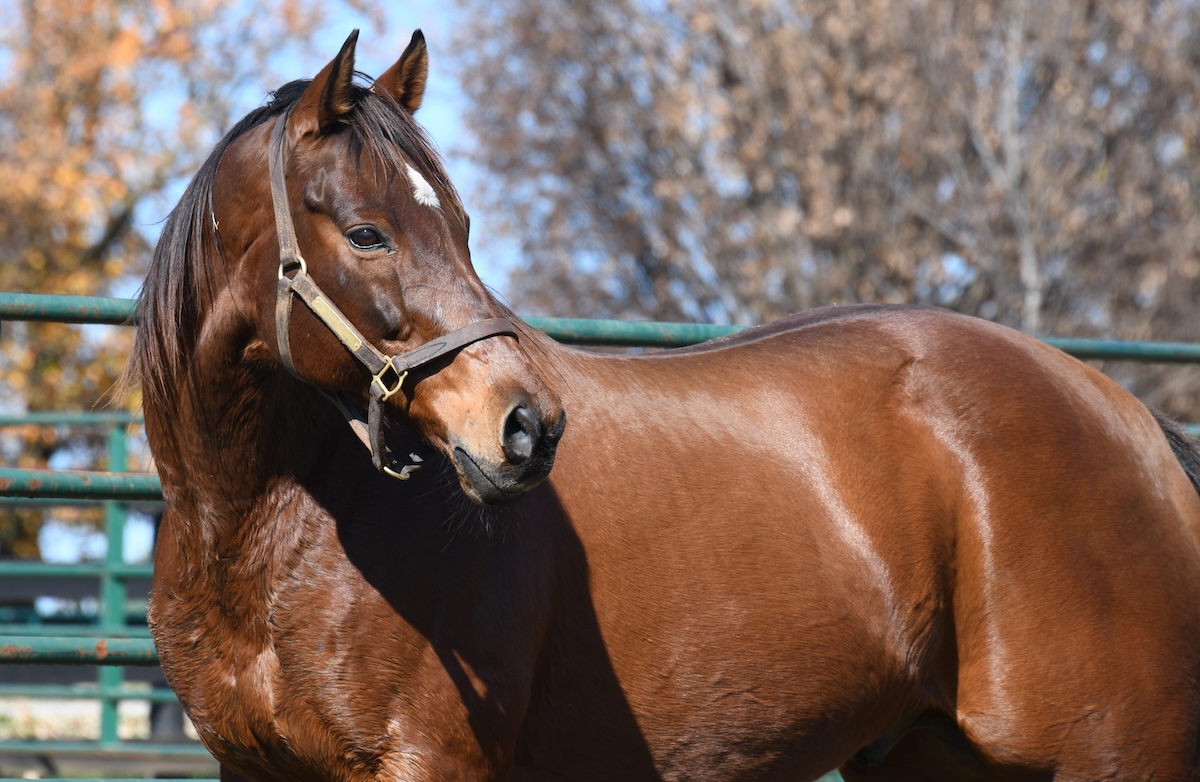 “That day we decided to retire him, and I called Michael Blowen at Old Friends in Kentucky,” Vaccarezza said. “We put him on a van at Palm Meadows, while I flew to Lexington the night before so I could be there to lead him off the van.”
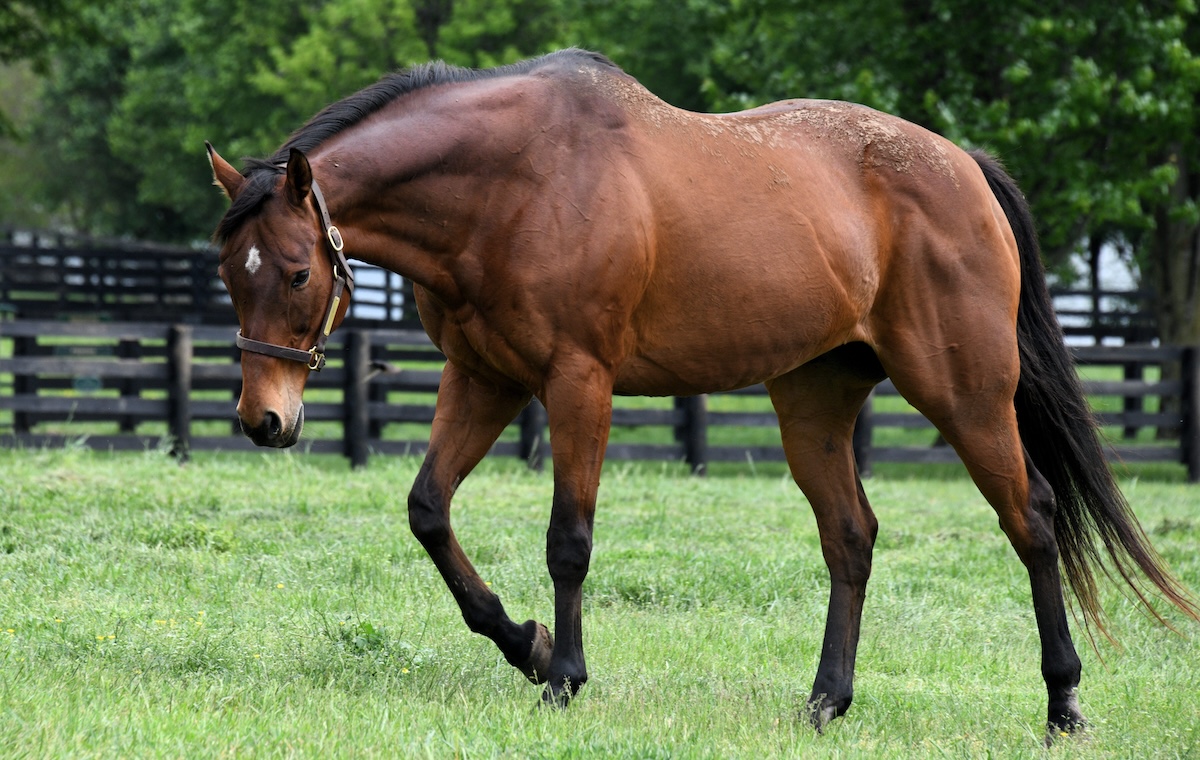
Little Mike arrived at Old Friends on July 29, 2016. After a routine quarantine, he took up residence in a large, sloping paddock by the main road with fellow gelding Game On Dude, a winner of just shy of $6.5m.
Only one month apart in age, they have made a perfect match and a popular attraction for Old Friends visitors, as they turn 19 together in 2026.
“We call it our ten-million-dollar paddock,” Blowen said. “Game On Dude may have earned more, but Little Mike is definitely in charge.”
On the afternoon of Feb. 14, 2018, while Little Mike was enjoying a routine visit from Blowen at Old Friends, Carlo Vaccarezza was preparing for a busy Valentine’s Day at his Frank & Dino’s restaurant near the family home in Parkland, an upscale Miami suburb just inland from coastal Boca Raton.
Meanwhile, Michael and Nicholas were nearing the end of their day at Marjory Stoneman Douglas High School when a 19-year-old man armed with an AR-15 entered a campus building and opened fire, killing 17 and wounding 18, both students and staff.
The Vaccarezza boys were in a different area of the school. “The worst part was not knowing where my brother was when the shots were fired,” Nick said not long after the shooting. “That’s my baby brother. Thank God he was sharp enough to get to me.”
 They escaped the chaos by running to the far end of the athletic field and vaulting an eight-foot chain link fence. Since then they have been routinely identified among the growing ranks of media-anointed ‘school-shooting survivors’.
“I’m at the lowest of the lows right now, and I’ve been at the highest of the highs, winning the Breeders’ Cup with Little Mike,” Nick said at the time. “I feel more than lucky. I feel blessed. And I’m looking forward to a different kind of interviews once I start my career.”
He got his wish. While Michael, now 23, has pursued a business career, Nick has followed his dreams – and his father – to a life in racing. After a stint working for champion trainer Chad Brown, 26-year-old Nick took out his license in 2025 and currently trains a string of 14 runners owned primarily by his family at Palm Meadows Training Center.
As for Carlo, he has opened a Frank & Dino’s in Lexington, which provides him with an excuse to visit Little Mike in nearby Georgetown as often as he pleases. It was hard, in the beginning, to say goodbye, something Michael Blowen has witnessed often at Old Friends.
“Later that summer, when I ran into Nick at Keeneland, he said there was something he wanted to ask,” Blowen said. “When his father left Little Mike that day at Old Friends, ‘Did he cry?’ The answer was yes.”
• Read all Jay Hovdey's features in his Favorite Racehorses series
Snow Chief: ‘The little black colt who humbled the best of his generation’
Lava Man: ‘Grace under pressure, time and time again … a horse who refused to lose’
Zenyatta: ‘A symphony in 20 inspiring parts … there’s little to compare’
View the latest TRC Global Rankings for horses / jockeys / trainers / sires